In the evolving tapestry of Cuban tobacco, few things capture the imagination of aficionados quite like a cigar that has vanished from shelves forever. The Quintero Miramars stands as a testament to a bygone era, representing a specific moment in the island’s rich manufacturing history. While the Quintero brand itself remains a staple for many smokers, this specific vitola has achieved a legendary, almost mythical status among collectors. It is no longer merely a smoke, but a tangible artifact from a time when production methods and brand portfolios looked significantly different than they do today.

A Relic of Pre-Revolutionary Production
The story of the Miramars begins in a transformative period for Cuba. This cigar made its debut prior to 1960, placing its birth in the pre-revolutionary golden age or the very earliest days of the revolutionary government’s consolidation of the industry. This timing is crucial for understanding its character and rarity. For roughly fifteen to twenty years, the Miramars enjoyed a place in the Quintero lineup, surviving the initial upheaval of the nationalization of cigar factories.
However, the window for this particular model was relatively short in the grand scheme of Cuban cigar history. By the 1970s, production ceased entirely. This discontinuation left a finite number of boxes in circulation, effectively turning the Miramars into a "closed edition." Unlike modern cigars that are produced continuously, the supply of Miramars can never be replenished, creating a scarcity that drives intense interest among historians and serious collectors who seek to preserve the legacy of mid-century Cuban tobacco.
Dimensions and Hand-Crafted Heritage
For the modern enthusiast accustomed to the robust girth of contemporary cigars, the specifications of the Quintero Miramars offer a glimpse into the preferences of past generations. The vitola measured 146 mm (approximately 5¾ inches) in length with a slender ring gauge of 40. This thinner format was once the standard for elegant smoking, allowing for a different concentration of flavor and burn dynamic than the thicker " gordos " favored in the 21st century.
One of the most defining attributes of the Miramars was its construction. In an era where mechanization was beginning to take hold in various industries, these cigars were unequivocally handmade. This artisanal approach is detailed in surviving records, confirming an official weight of 8.46 grams per unit. The dedication to hand-rolling a thinner cigar requires significant dexterity, ensuring the draw remains perfect despite the narrower column of tobacco. This human touch is part of what makes surviving examples so prized; they represent the unadulterated craftsmanship of the mid-20th century Cuban torcedor.
Design and Presentation
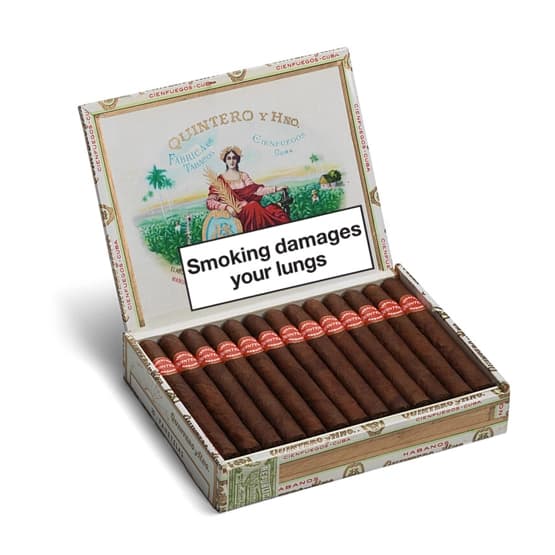
The visual identity of the Quintero Miramars distinguishes it from the standardized branding seen in later decades. During its production run, the cigar featured a unique, custom band design. This early aesthetic choice stands in contrast to the later homogenization of brand imagery, where distinct vitolas often shared identical band styles. Collectors often note that this specific labeling points to a time when individual cigars within a brand house were marketed with more distinct personalities.
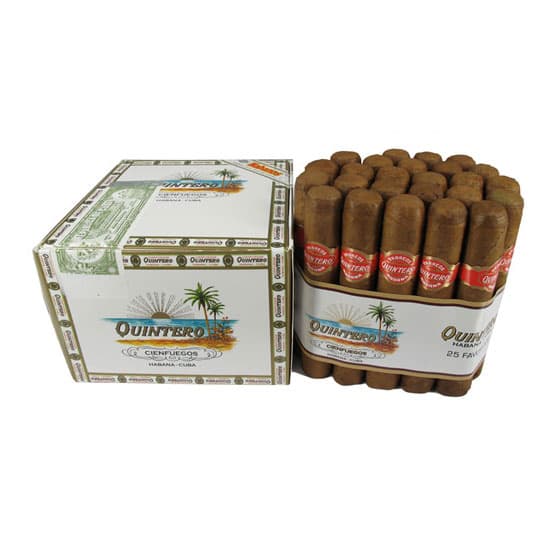
Packaging for the Miramars was designed to reflect its premium status within the Quintero family. The cigars were presented in dress boxes of 25, a traditional and elegant method of storage. These "cajas" were not merely shipping containers but an integral part of the luxury experience. Finding an original dress box today is exceptionally rare, as time and storage conditions have claimed many of these fragile containers, leaving loose cigars or partial boxes as the more common discovery.
The Collector's Pursuit
Why does the Quintero Miramars continue to matter decades after it disappeared from the market? The answer lies in the intersection of scarcity and authenticity. Because the cigar was discontinued in the 1970s, every surviving example is a piece of history that has likely undergone decades of aging. This natural maturation process transforms the tobacco, offering flavor profiles that are impossible to replicate in fresh production.
- Rarity: The limited production window of under two decades ensures that very few authentic units exist.
- Craftsmanship: As a fully handmade cigar from a brand that later shifted focus, it represents a pinnacle of Quintero's manufacturing capabilities.
- Historical Value: The custom band and dress box presentation offer a visual lesson in Cuban marketing history.
For the serious collector, finding a Quintero Miramars is about more than just smoking; it is about owning a slice of the past. The cigar serves as a benchmark for the Quintero brand's evolution and a reminder of the shifting trends in vitola popularity over the last half-century.