The Historical Significance of the Laguito
The story of the Davidoff No.2 begins in 1969, a time when the Cuban tobacco industry was navigating a complex political and economic landscape. Zino Davidoff, a man whose name was already synonymous with fine tobacco, entered into a groundbreaking arrangement with Cubatabaco. This partnership resulted in a series of cigars that would set a new global standard for luxury smoking. The No.2 was a cornerstone of this initial release, designed to showcase the very best leaf the island had to offer.

Production of this specific vitola continued for more than two decades, finally ceasing in 1991. This discontinuation marked the end of Davidoff's presence in Cuba, as the brand eventually shifted its manufacturing operations to the Dominican Republic. Consequently, every surviving Davidoff No.2 serves as a frozen moment of time, produced before the split and representing a distinct flavor profile that modern production has never quite replicated. The cigar stands as a testament to the quality control and blending philosophies prevalent in Havana during the latter half of the 20th century.
Dimensions and Construction Details
The technical specifications of the No.2 reveal a cigar built for elegance rather than brute force. In the factory, it was known by its internal name, the Laguito No.2. This nomenclature is crucial for authentication purposes, as it ties the cigar directly to the prestigious El Laguito factory, the birthplace of the Cohiba brand and the center of Cuba's premium cigar production.
The physical dimensions of the smoke are as follows:
- Length: 152 mm (approximately 6 inches)
- Ring Gauge: 38
- Official Weight: 8.15 grams
By modern standards, a ring gauge of 38 is considered slender. However, this thinner format allows for a tighter roll and a concentration of flavor that can be lost in wider "gordo" formats. The construction was always handmade, utilizing the finest wrapper leaves available, often characterized by a silky, oily sheen that signaled high-quality Cuban tobacco. The band used was the standard Davidoff design of that era, distinguishing it clearly from the yellow-banded Zino series or the later Dominican productions.
Presentation and Packaging Variations
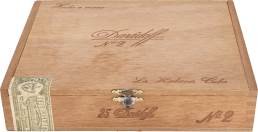
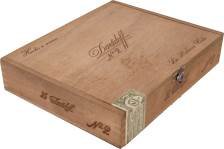
Throughout its production lifecycle, the No.2 was marketed in a variety of packaging styles, ranging from everyday purchases to elaborate collector's sets. Finding these original boxes in pristine condition is now a challenge in itself, as the materials have aged alongside the cigars. Collectors hunting for these vintage tins or boxes should be aware of the different formats that were originally available on the market.
The primary packaging options included:
- Cardboard packs containing 5 cigars
- Semi boîte nature boxes holding 10 cigars
- Semi boîte nature boxes containing 25 cigars
- Slide lid boxes (often highly sought after) containing 50 cigars
- Larger capacity semi boîte nature boxes of 50 cigars
Collectibility and Market Value
Since the final Cuban Davidoff rolled off the line over thirty years ago, the No.2 has transitioned from a luxury consumer good to a rare collectible. The secondary market for these items is driven by scarcity; well-preserved boxes or even single cigars command premium prices. The allure is driven by the irreplaceable nature of the tobacco. Cuban Davidoffs from this era are renowned for their distinct aging potential, offering a flavor profile that is often described as rich, earthy, and incredibly smooth due to decades of maturation.
For the modern collector, the Davidoff No.2 is more than a purchase; it is an investment in a defunct piece of history. It represents a time when the "Laguito" factory was the undisputed center of the premium cigar universe. As availability continues to shrink, the legacy of the No.2 only grows, cementing its status as a legendary piece of the Zino Davidoff story.