
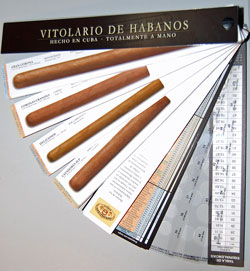
Picture a slender stack of glossy panels that opens like a hand‑held fan, each sheet revealing a different Cuban vitola in its true size. That is exactly what the 2008 Vitolario de Habanos Guide delivers—a compact, tactile catalog that lets aficionados leaf through the entire Habanos range as it existed at the close of the first decade of the 21st century. Far more than a mere picture book, this guide functions as a living archive for collectors, researchers, and anyone fascinated by the craft of Cuban cigar making.

A Handy Encyclopedia of Cuban Cigars
Origins and Purpose
Released officially by Habanos S.A., the guide was conceived to serve as the ultimate reference for understanding the breadth of Cuban cigar production. Its pages capture every factory vitola that was being rolled in Cuba at the time, providing a clear snapshot of the industry’s layout in 2008. Although the content was finalized in 2008, the publication did not hit the market until late 2009, creating a brief but notable lag that adds a curious footnote to its history.
Design Philosophy
The guide’s format is as distinctive as the cigars it describes. Each page consists of a high‑quality glossy strip measuring 275 mm × 40 mm. These strips are bound together with a series of pins that allow the entire booklet to be fanned out in one smooth motion. This design not only evokes the elegance expected of premium Cuban products but also makes side‑by‑side comparison of vitolas effortless for the user.
Inside the Pages: What You’ll Find
Visual Catalog
Every vitola produced by the Cuban factories as of 2008 is reproduced at actual size. The full‑size illustrations enable readers to identify subtle differences in shape, length, and ring gauge that are often lost in smaller diagrams. Each illustration is paired with a concise notation indicating which Habanos brands employ that particular vitola, creating a handy cross‑reference for collectors hunting specific formats.
Brand Profiles and Context
Beyond the visual catalogue, the guide devotes space to detailed portraits of each Cuban brand. These narratives provide historical background, key characteristics, and the typical flavor journey associated with each line. For newcomers and seasoned smokers alike, this contextual layer enriches the understanding of why certain vitolas became iconic.
Helpful Tools
- Ring‑gauge templates: Printed cut‑outs that let you measure the diameter of any cigar quickly.
- Metric‑to‑imperial conversion charts: Effortlessly translate millimeters to inches and grams to ounces.
- Flavor and strength ratings: Concise descriptors of taste profiles, from subtle notes of cedar and coffee to bold hints of pepper and earth.
Together, these tools transform the guide from a passive reference into an active companion for both the humidor and the retail counter.
Historical Significance and Collectibility
A Time‑Capsule of 2008 Production
Because the guide records the complete Habanos lineup as it stood in 2008, it functions as a historical time‑capsule. Several vitolas featured have since been discontinued or altered, making the publication an essential record for tracking the evolution of Cuban cigar manufacturing. Scholars and historians use it to trace brand lineage, monitor shifts in popularity, and verify the authenticity of vintage cigars.
Market Availability and Language
The guide was printed primarily in Spanish, a fact that has been confirmed. The existence of translations into other languages remains unverified, so the Spanish version is considered the definitive edition. Its delayed release—appearing in 2009—adds a layer of intrigue, as early adopters often found themselves holding a publication dated 2008 that was still fresh off the press months later.
Why the Guide Matters Today
In the ever‑changing world of premium cigars, having a reliable snapshot of a specific era is priceless. The 2008 Vitolario de Habanos Guide provides that snapshot, marrying visual precision with contextual insight. Whether you are a collector seeking to verify a rare vitola, a retailer arranging a display, or a historian reconstructing the narrative of Cuban cigar culture, this guide offers a concise yet comprehensive foundation.
Its elegant fan‑style layout, practical measurement aids, and brand‑level narratives make it far more than a static catalogue—it is a living reference that continues to inform and inspire the global community of Cuban cigar enthusiasts.