Guides
Cigar wrapper shades and terminology
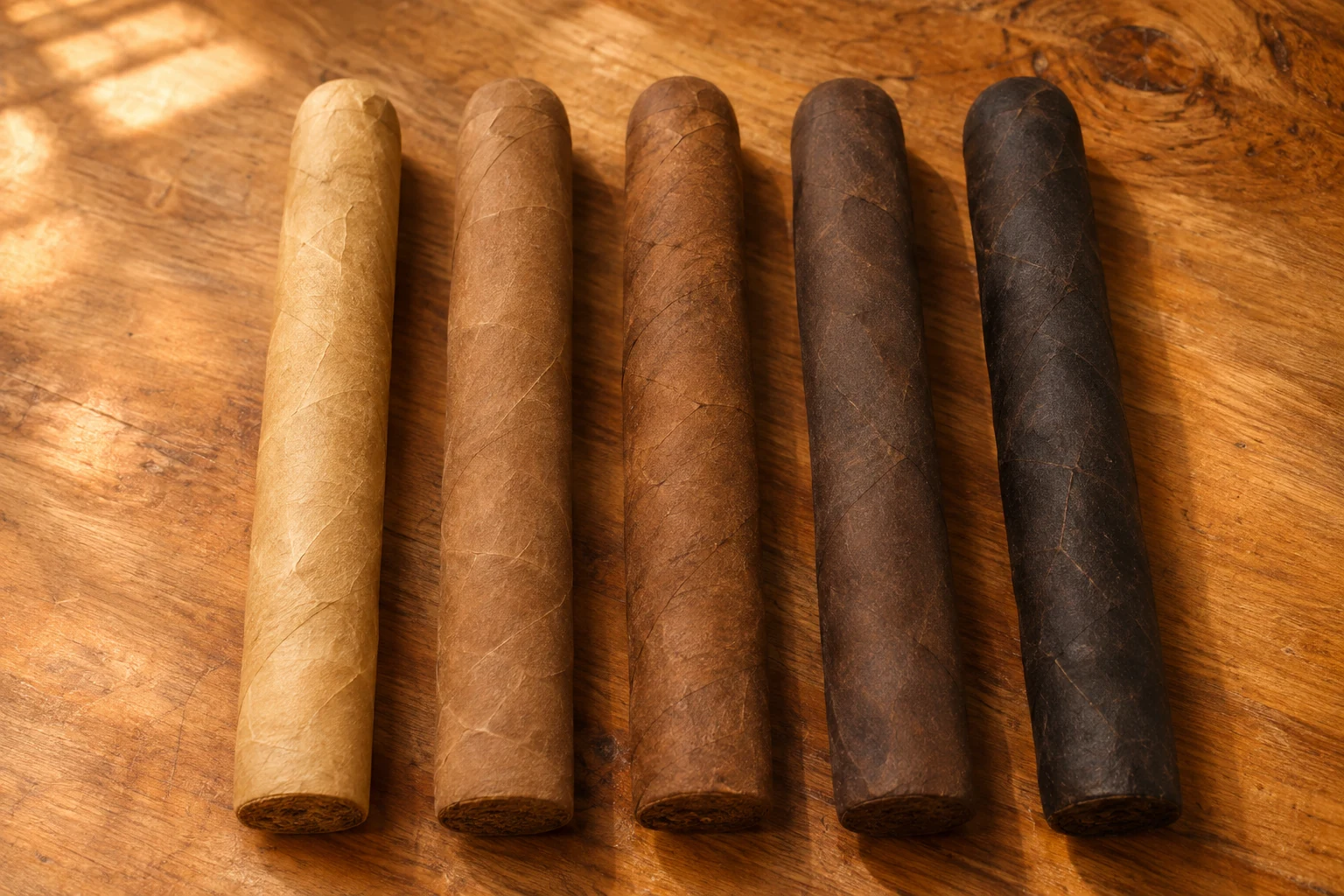
A cigar wrapper is the outer tobacco leaf, called the capa in Spanish. Terms such as claro, colorado, maduro and oscuro usually describe its colour or appearance. They are not a universal scale of nicotine content, a complete description of the blend or proof of geographic origin. Some wrapper names instead refer to a tobacco type or growing tradition.
Wrapper, binder and filler
The wrapper surrounds the outside of a cigar. Beneath it, the binder holds the filler together. In Spanish terminology these components are capa, capote and tripa respectively. The Habanos glossary distinguishes these structural roles. A description of the wrapper concerns one component rather than everything inside the finished object.
This distinction prevents a common reading error. A leaf name attached to the wrapper does not necessarily identify the binder or filler. Similarly, a colour description says nothing by itself about the number of different tobaccos in the blend. Component, colour and composition should be read as separate pieces of information.
Claro and the lighter shades
Claro generally indicates a light brown wrapper. Descriptions may use tan or golden brown to explain the appearance, but these words are approximate visual comparisons. They do not define a standard laboratory colour coordinate. A label can remain the same despite small natural variations between individual leaves.
Double claro and candela are commonly used for a greenish wrapper category. The terminology is broader than a single country's production system, and not every catalogue uses every category. It is therefore useful to identify whose terminology is being followed before assuming that a sequence of colour names is universal.
Colorado and its neighbouring terms
Colorado describes a brown shade, often discussed in relation to reddish-brown tones. Colorado claro and colorado maduro place the description towards the lighter and darker sides of that broad category. The Habanos glossary uses its own brown-shade descriptions for these terms, while other sources may describe the boundaries slightly differently.
These differences do not necessarily mean that one observer has identified a different leaf variety. Colour categories compress a continuous range of appearances into a small vocabulary. Adjacent labels can therefore overlap, especially when people compare photographs made under different lighting or use terminology drawn from different production traditions.
Maduro and oscuro
Maduro literally means ripe or mature and is widely associated with a very dark brown wrapper. In cigar terminology it can also carry a processing association, particularly with fermentation. The word alone does not disclose a precise fermentation schedule, a harvest date or the age of the finished cigar.
Oscuro describes the darkest end of the usual colour vocabulary, approaching black. It should not be read as an automatic ranking of strength. La Aurora's wrapper terminology article gives examples of these shade names and explicitly distinguishes wrapper darkness from the strength of the complete blend.
Why a leaf changes colour
Leaf position on the plant and subsequent processing can influence appearance. Habanos explains in its account of colour sorting that upper leaves tend to be darker and can darken further during fermentation. This explains why appearance cannot be reduced to a single factor such as the country where the leaf grew.
Curing, fermentation and storage are distinct stages. A colour term does not give a complete account of them. It also cannot prove that two visually similar wrappers underwent identical processing. Observed colour is the result being described, while the history of the material requires separate documentation.
Names that are not simply colours
A wrapper description may combine a leaf type with a place of cultivation or a growing method. Such a phrase contains different kinds of information from a simple colour word. “Habano wrapper,” for example, is used for tobacco grown outside Cuba as well as in discussions of Cuban tobacco ancestry.
That use should not be confused with the protected Habanos denomination for qualifying Cuban cigars. The wrapper descriptor and the denomination answer different questions. Neither a dark wrapper nor a familiar leaf name can independently establish where the whole cigar was manufactured or whether it belongs to a protected origin category.
Limits of visual comparison
Colour changes with lighting, camera white balance, screen settings and reflections from the leaf surface. A photograph can document appearance, but it is a poor basis for an exact comparison when those conditions differ. Even photographs of the same object may suggest different shades without any actual change in the material.
For a neutral description, record the source's term and explain what it describes. Avoid adding inferred flavour, nicotine, age or origin claims solely from appearance. Wrapper vocabulary is useful for identifying visible features and reading historical or technical descriptions; its usefulness depends on preserving the boundaries between those observations and claims that require other evidence.
Reader questions
Questions & answers
No questions yet. Ask the first one.