In the rarefied air of luxury tobacco collecting, few artifacts command as much reverence as those produced before the Cuban Revolution. Among these historic relics, the La Corona Policromia White occupies a unique space, serving as a tangible link to a bygone era of craftsmanship and commerce. Created specifically for the esteemed retailer J. J. Fox, this cigar is more than a smoking experience; it is a piece of branding history that survived dramatic shifts in the industry, telling a story of exclusivity and evolution through its very existence.

A Distinctive Retailer Exclusive
The Policromia White was never intended for mass consumption on a global scale. Instead, it was crafted as a special production for J. J. Fox, one of the world’s most distinguished tobacconists. This exclusivity places the cigar in a special category of "Regional Editions" before such terminology became standard marketing jargon. It highlights a time when relationships between factories and retailers were close enough to spawn unique, tailored blends that bore the retailer's mark alongside the factory's heritage.
Physically, the cigar is a testament to the classic formats of the mid-20th century. It is a handmade creation, measuring 114 mm (approximately 4½ inches) in length with a ring gauge of 44. These dimensions result in a slender, elegant vitola, weighing in at an estimated 6.90 grams. For the modern smoker accustomed to thicker robustos, this format offers a different kind of smoking experience—one focused on balance and finesse rather than sheer volume.
- Factory Name: Unknown (Produced under the La Corona umbrella)
- Dimensions: 114 mm (4½″) length x 44 ring gauge
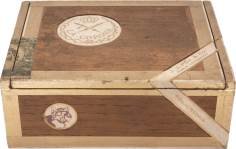
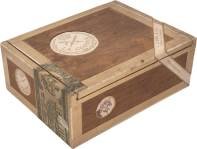
- Packaging: Dress boxes and semi boîte nature boxes, each containing 25 cigars
Evolution of a Label
One of the most intriguing aspects of the Policromia White is its visual presentation, which underwent significant changes throughout its lifespan. Initially, the cigar was adorned with a dual-band configuration. The primary band was the standard La Corona Policromia design, which was accompanied by a secondary white band. This double-banding served to immediately distinguish the "White" variant from other lines in the portfolio, signaling its specific blend and exclusive nature to the discerning eye.
However, the 1970s brought a streamlined approach to the brand's aesthetics. The dual bands were eventually replaced by a single "Poli-cromia White" band. This change was not merely cosmetic; it reflected a broader strategic shift. By the late 1970s, the branding underwent an even more dramatic transformation. The line effectively severed its ties to the parent La Corona marque. Where the cigars were once marketed clearly under the La Corona umbrella, they transitioned to featuring only Poli-cromia labels. This move elevated Policromia to a standalone designation, a bold move that redefined the brand's identity in the marketplace.
From Pre-Revolution to Obsolescence
The historical timeline of the Policromia White places it firmly within the "pre-revolution" category, a term that carries immense weight among aficionados. The cigar entered the market prior to 1960, meaning the earliest examples were rolled in a Cuba that was vastly different from the one that emerged under Fidel Castro. The fact that production continued for decades after the revolution speaks to the enduring popularity and quality of the blend, bridging two distinct eras of Cuban history.
Despite its resilience, the Policromia White was not destined to last forever. Production eventually ceased during the 1980s, closing the book on this specific expression. Today, surviving boxes from the pre-1960 era are considered museum-grade artifacts, while the later productions from the 70s and 80s offer a glimpse into the transitional period of Cuban cigar manufacturing. The discontinuation of the line has only added to its mystique, turning it into a "holy grail" item for serious collectors.
Notes for the Modern Collector
For those fortunate enough to encounter a box of La Corona Policromia White, a degree of numismatic caution is advised. As with many vintage Cuban cigars, the published dimensions and weights should be treated as guidelines rather than absolute laws. Because these were handmade products from a different era, natural variations exist between surviving specimens. The measurements available today are derived from the few remaining examples that have survived the ravages of time, humidity, and consumption.
The presentation was equally varied, with cigars found in both standard dress boxes and the more rustic semi boîte nature boxes. Each format of packaging offers a different visual story of how premium tobacco was sold and stored forty to sixty years ago. As part of the broader J. J. Fox Exclusives collection, the Policromia White remains a fascinating footnote in the annals of tobacco history—a white-band wonder from a golden age.