
Guides
How a humidor works
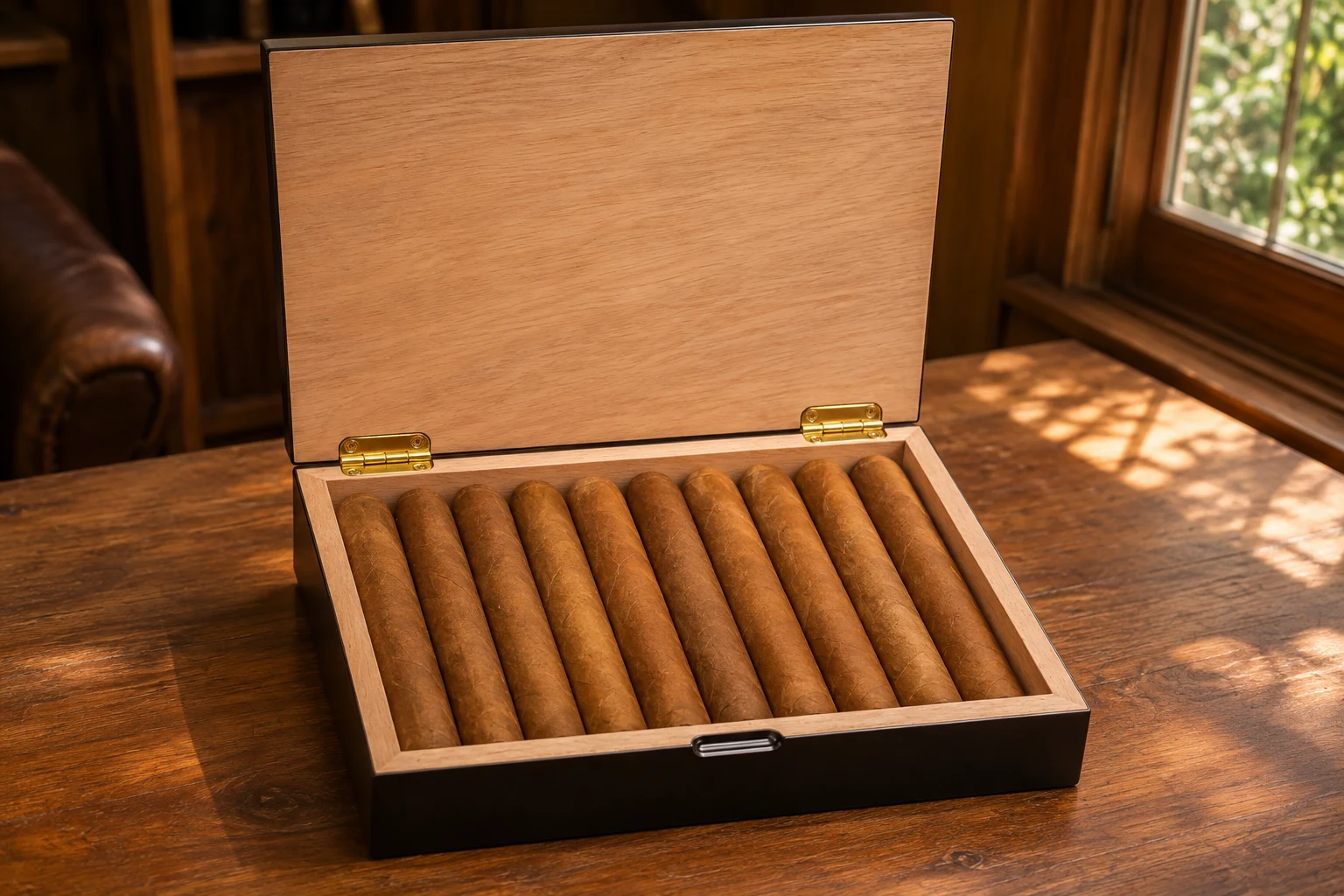
A humidor works by slowing air exchange and providing a controlled source or buffer of water vapour inside an enclosure. The air, wooden lining and stored tobacco exchange moisture until they move towards equilibrium. A hygrometer measures the air's relative humidity; it does not directly measure the water content of the tobacco or automatically control the environment.
What relative humidity measures
Relative humidity, usually abbreviated RH, compares the actual water vapour pressure with the saturation vapour pressure at the same temperature. It is expressed as a percentage. The temperature qualification matters: an RH reading is not simply a count of water molecules in a box. Heating or cooling can change the reading even before water enters or leaves.
In an idealised closed air space with no moisture exchange with surrounding materials, cooling raises RH and warming lowers it. A real humidor is more complicated because wood, tobacco and the humidity device also absorb or release water. This is why a temperature change and a humidity change should be examined together rather than treated as unrelated events.
The enclosure slows exchange
An enclosure reduces the rate at which its contents exchange moisture with the room. Opening the lid temporarily changes that boundary. Gaps, poorly fitting doors and damaged seals can allow continuing exchange even when the container looks closed. A humidity source then has to compensate for the surrounding environment as well as the contents.
A tight enclosure is not a sterilising chamber. It does not remove existing contamination or prevent every local difference in moisture. Its role is to make the internal environment more manageable. How well it does that depends on construction, the room conditions and how often it is opened, not simply on its external dimensions.
Why cedar appears in humidors
Wood is hygroscopic: it takes up and releases moisture as the surrounding conditions change. A wooden lining therefore contributes to the enclosure's moisture balance. Spanish cedar is commonly used in humidors, but a cedar lining is not an independent humidity controller. It has a finite capacity to exchange moisture and cannot compensate indefinitely for an unsuitable environment.
The same property explains why a dry lining initially changes the conditions inside a new box. Water vapour supplied to the enclosure can enter the wood instead of remaining in the air. Conversely, previously damp wood can release moisture later. Treating the lining as an active part of the system helps explain changes that otherwise seem mysterious.
What seasoning means
Seasoning a wooden humidor means allowing its lining to become conditioned to a humid environment before normal use. It is a moisture-equilibration process, separate from the curing of harvested tobacco leaves. Its duration depends on the construction and the method specified for that enclosure; a fixed timetable is not a universal physical rule.
The manufacturer's instructions should determine the method. Directly soaking thin wooden parts can cause swelling or distortion, and a wet surface is not evidence that moisture has become evenly distributed through the wood. Newair's discussion of humidor seasoning describes the role of dry wood and the risks of excessive wetting. Instructions for one construction should not be assumed to apply to every other design.
Humidity devices have different jobs
A simple wet reservoir supplies water by evaporation. An electronic system can use a sensor and controller to operate a fan or another humidifying component. A two-way humidity material can exchange moisture in either direction within its working capacity. These mechanisms are different, even when the devices occupy the same position inside a box.
The hygrometer is a separate part of the explanation. A display can report changing conditions without controlling them. Likewise, a device's nominal setting does not prove that every corner of an enclosure has reached that value. Sensor location, response time and instrument error all affect the relationship between the display and the stored material.
Temperature and local conditions
An ordinary passive humidor does not actively cool its contents. Sunlight, a nearby heat source or a cold external wall can therefore affect its internal conditions. Local cool surfaces can have higher relative humidity than warmer areas. A central reading may miss such differences, particularly in a large or densely filled enclosure.
The Canadian Conservation Institute's reference on incorrect relative humidity explains why moisture conditions matter for organic materials. For understanding a humidor, the useful principle is to follow the whole system: room temperature, enclosure, moisture source, absorbent materials and measurement. A single number describes one observation; it does not describe every process occurring inside.
Reader questions
Questions & answers
No questions yet. Ask the first one.