
Guides
How Collectors Read a Habanos Box
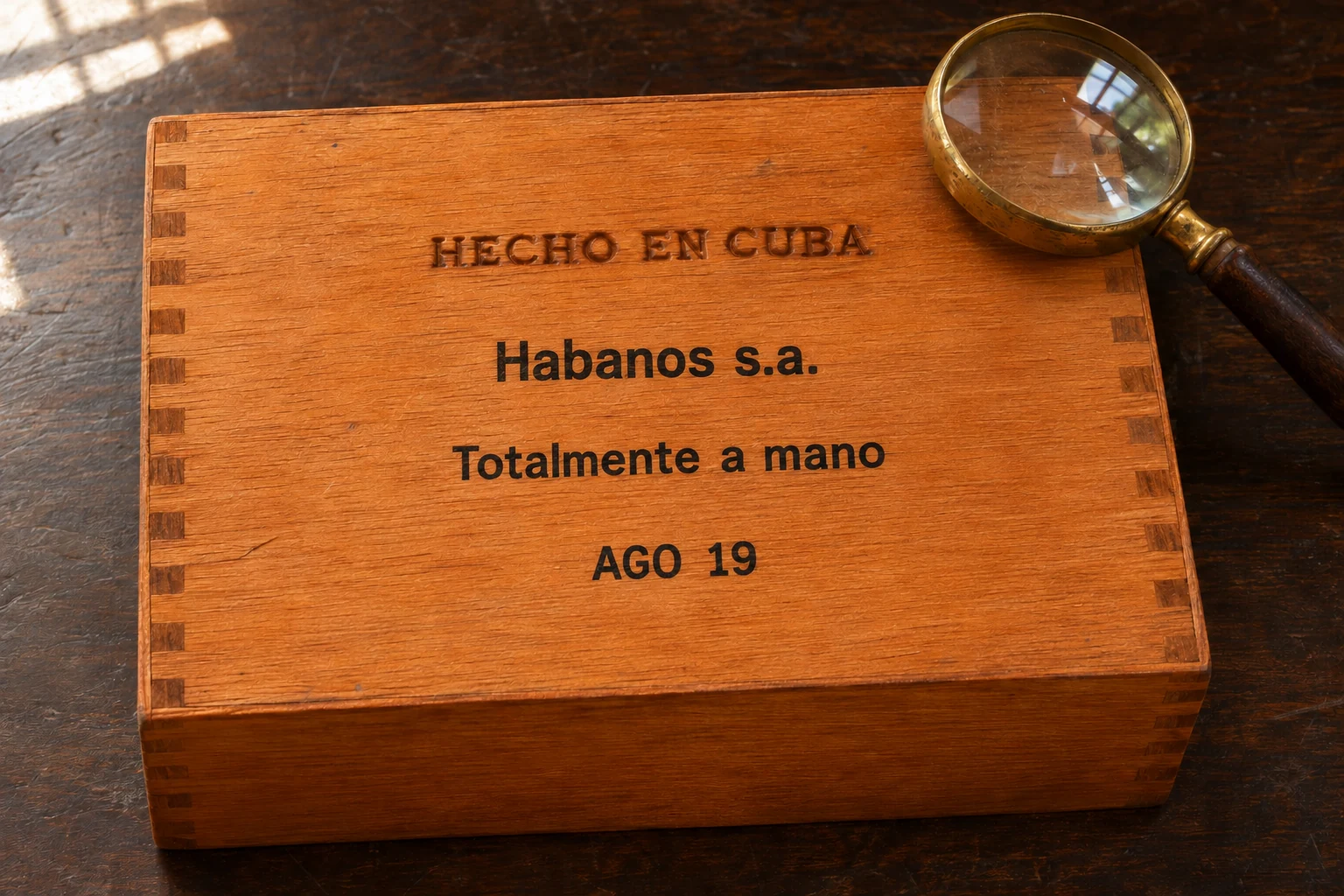
Collectors read a Habanos box from its warranty seal and the stamps on its underside. The seal indicates the era of the box, the factory code shows where the cigars were rolled, and the date stamp shows when they were boxed. Together these marks establish a box's age, which is what most of its value as a collectible rests on.
Why the box matters as much as the cigars
We buy from other collectors and resell, so these marks matter to us on every box. A cigar on its own says little about when it was made. The box does. Age changes how a cigar smokes and what it is worth, and the only dependable record of that age is printed, stamped and glued onto the packaging.
The warranty seal
The green and white seal is the oldest mark on the box. Its design descends from a Cuban law of 1912, and it has been revised in stages. Revisions in 1931 and 1999 changed its details, the second adding security features, and the 2009 version added a hologram and an individual barcode. A seal without a hologram therefore suggests an older box, and a box with a recent date stamp should have one.
The marks on the underside
Three printed or branded phrases appear on most modern boxes, and each helps to date it.
- Hecho en Cuba has been branded into the bottom of Havana boxes since 1960.
- Habanos S.A. identifies the company that markets the cigars.
- Totalmente a mano has appeared since 1989 on boxes of long filler handmade cigars.
The factory code
Ink stamps showing the factory and the date were introduced on Habanos boxes in 1985. The factory code is a short abbreviation, usually two to four capital letters, that identifies where the cigars were made. Collectors track these codes because particular factories have strong reputations for particular cigars, and many will pay more for a preferred combination.
Reading the date stamp
Since 2000 the date has been easy to read: a three letter Spanish month and a two digit year. AGO 19 means August 2019. Learning the Spanish months is enough to read any recent box.
| Stamp | Month | Stamp | Month |
|---|---|---|---|
| ENE | January | JUL | July |
| FEB | February | AGO | August |
| MAR | March | SEP | September |
| ABR | April | OCT | October |
| MAY | May | NOV | November |
| JUN | June | DIC | December |
Decoding older boxes
Before 2000 the date was hidden in four letters based on the word NIVELACUSO. Its ten letters stand for the digits 1, 2, 3, 4, 5, 6, 7, 8, 9 and 0, in that order. The first two letters give the month and the last two give the year.
A stamp reading NISC therefore means 12 and 97, or December 1997. Some boxes dropped the leading zero, so three letters such as CSC read as July 1997. A later key word, CODIGUNETA, was introduced in 1998 and changed the order of the digits, and some boxes from those years mix the schemes, so read any late 1990s date against the rest of the box.
When the marks do not agree
The marks are most useful when you compare them with each other. A date stamp from one era on a seal from another, a phrase that was not in use at the claimed date, or a factory code in the wrong style all need an explanation. Sometimes there is a good one, since old stock was occasionally boxed or sealed later. More often it is the first sign of a problem, and our Cohiba authenticity checklist is the next place to go.
What to photograph
When you buy or sell a box between collectors, the same few photographs answer most questions: the seal in full, the underside with its stamps in sharp focus, the open box showing the count, and a close view of one band. Good pictures of those four things are worth more than a long description.
Reader questions
Questions & answers
No questions yet. Ask the first one.