
In the rarefied air of luxury tobacco collecting, few things capture the imagination quite like a discontinued brand from Havana’s golden age. While names like Cohiba and Montecristo have become household staples, there is a quiet prestige associated with discovering a marque that time has largely forgotten. Don Alfredo stands as one of these enigmatic footnotes in the annals of cigar history—a brand that existed for a fleeting moment, roughly fifteen years, before vanishing from production lines forever. For the modern historian and collector, these artifacts represent more than just tobacco; they are physical remnants of a transformative era in Cuban industry.
The Personal Touch of a Bygone Era
The mid-20th century was a period defined by significant upheaval and restructuring within the Cuban tobacco industry. Amidst the consolidation of private enterprises into state-run entities, many smaller labels were absorbed or erased. Don Alfredo managed to carve out a niche during this chaotic time. The brand name itself carries a distinctly personal connotation, hearkening back to a tradition where master blenders and factory owners lent their own identities to their products. This was a stark contrast to the often anonymous, mass-market branding that would characterize the global cigar boom in later decades.
Surviving examples from this period suggest a commitment to quality that defied the industrial streamlining of the day. The name implies a singular vision—a "Don" overseeing the process—rather than a faceless collective. This human element is precisely what makes surviving boxes and bands so valuable today; they serve as a reminder of the individual craftsmanship that once defined the island’s export economy.
Distinctive Aesthetics: The Embossed Standard
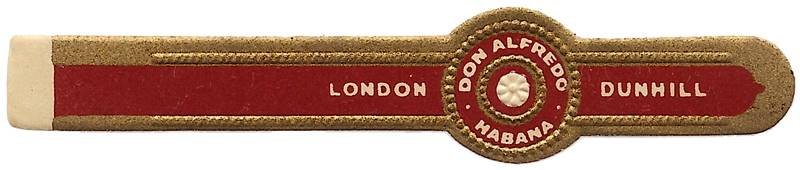
One of the most defining characteristics of the Don Alfredo brand was its visual presentation. Aficionados and archivists have long noted the specific use of what is classified as "Standard Band A" design. Unlike the simpler, flat paper bands used on lower-tier export products, Don Alfredo wrappers featured a sophisticated embossed finish.
- Visual Depth: The embossing process raised portions of the ink and paper, giving the band a three-dimensional quality that caught the light differently than standard prints.
- Tactile Experience: This texture provided a physical heft and premium feel, signaling to the consumer that the cigar within was a product of high merit.
- Design Consistency: The use of this specific band type helps modern authenticators date the product, linking it inextricably to the production standards of its time.
This attention to packaging detail was not merely ornamental; it was a necessary signal of quality in a crowded marketplace. The design remained consistent throughout the brand's active years, serving as a reliable hallmark for smokers seeking a genuine experience.
The 1982 Discontinuation and Industry Shifts
The story of Don Alfredo came to an abrupt end in 1982. This discontinuation was not an isolated incident but rather part of a sweeping strategic overhaul by the Cuban tobacco authorities. By the early 1980s, the industry had moved firmly away from the fragmented landscape of previous decades. The goal was to streamline operations and focus marketing muscle on a select few "global brands" that could command international dominance.
Consequently, smaller marques that did not achieve massive commercial scale were systematically phased out. Don Alfredo, despite its quality and distinctive branding, fell victim to this rationalization. The resources and factory time previously allocated to this label were redirected toward bolstering the production of the industry's heavy hitters. This pivotal moment marked the end of the "transitional era"—a bridge between the old private workshops and the modern, centralized Cuban cigar industry we recognize today.
Hunting for History: The Modern Collector’s View
Today, finding a Don Alfredo cigar is akin to uncovering a buried treasure. Because the brand has been defunct for over four decades, the remaining inventory exists solely in the realm of the secondary market, private humidors, and specialized auctions. The value of these items has shifted from the smoke itself to the artifact as a historical object.
Collectors prize these items for several specific reasons that go beyond the flavor profile of the aged tobacco:
- Rarity Factor: With no new production since 1982, the supply is finite and dwindling.
- Historical Snapshot: The band design and box construction offer insights into manufacturing aesthetics of the late 1960s and 1970s.
- Investment Potential: As interest in "pre-embargo" and "transitional era" cigars grows, even lesser-known brands like Don Alfredo are seeing appreciation in value.
Ultimately, Don Alfredo serves as a tangible lesson in the impermanence of commercial brands. While the name no longer adorns humidors in retail shops, its legacy survives through the embossed bands and dusty boxes that collectors cherish. It remains a silent witness to an era when the Cuban cigar world was in flux, bridging the gap between artisanal tradition and industrial modernity.