
Guides
Which water to use in a humidor, and why
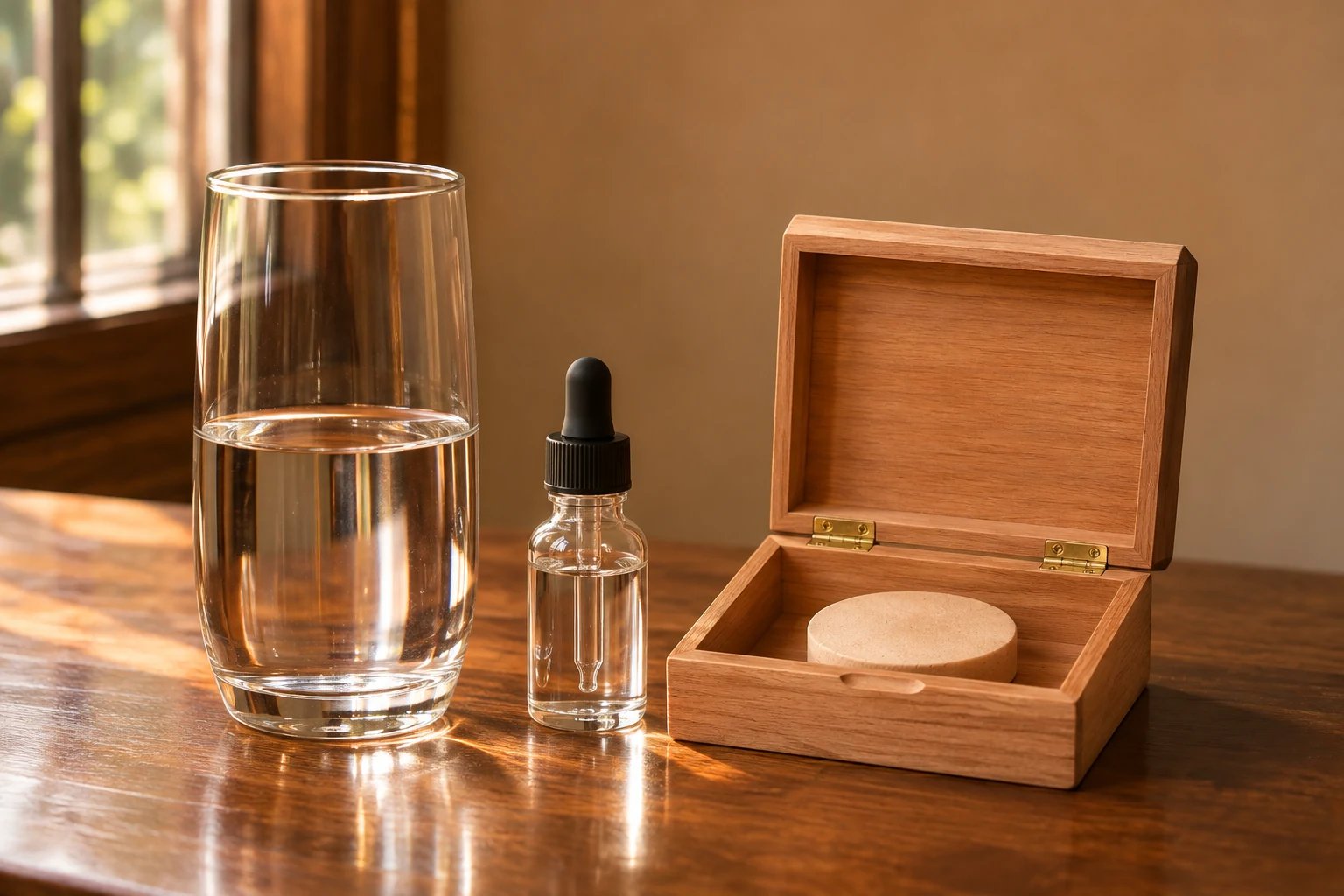
For a refillable humidor device that specifies water, use distilled water as its manufacturer directs. Some traditional foam humidifiers instead specify a prepared solution containing propylene glycol. These are different maintenance requirements. Sealed humidity packs are another category: they are not water reservoirs to refill. Identify the device before choosing a liquid or adding anything to it.
Why the water specification matters
Water used in an evaporative device leaves some of its dissolved material behind as it evaporates. Repeated refilling can therefore concentrate substances in the reservoir or on the humidifying medium. The reason to distinguish water types is not their appearance: clear water can still contain dissolved minerals that are invisible to the eye.
Distillation separates water through evaporation and condensation, greatly reducing many nonvolatile dissolved substances. In this application, a principal advantage is reducing mineral residue. That does not mean an opened bottle, reservoir or sponge remains sterile. Water quality and the cleanliness of the equipment are related but separate questions, and one cannot replace attention to the other.
Tap, spring and filtered water
Tap water varies with the supply and treatment system. Spring and mineral waters are also defined partly by their dissolved constituents, so a bottle labelled suitable for drinking is not automatically suitable for a device that requires distilled water. Drinking-water suitability answers a different question from compatibility with a small humidifying mechanism.
“Filtered” describes a treatment, not a single resulting composition. Some domestic filters improve taste while leaving much of the dissolved mineral content in place. Boiling is also not equivalent to collecting distilled water: boiling water in a kettle does not remove the dissolved minerals from the liquid left in that kettle.
What propylene glycol does
Propylene glycol is a hygroscopic compound, meaning that it has an affinity for water. It is used in some prepared humidor liquids to modify moisture behaviour. Its presence changes the properties of the liquid; it is not simply a different name for distilled water. The appropriate formulation depends on the humidifier's design.
Traditional sponge-based humidifiers and polymer-based devices do not necessarily accept the same liquid. The Humidor Guide discussion of humidifier liquids explicitly distinguishes these categories. Its device-specific distinction is useful, but broad claims that a liquid prevents every case of mould should not be treated as a guarantee of sterile conditions.
A prepared solution should be used only where the equipment instructions call for it. Adding extra glycol does not establish a known humidity by itself. Concentration, exposed surface area, the condition of the medium and the surrounding enclosure all matter. A general-purpose chemical bottle is not a substitute for a specified maintenance fluid.
Different devices require different handling
An electronic humidifier may have a refillable cartridge, a wick or another reservoir arrangement. Its maintenance instructions determine both the liquid and the filling procedure. A passive foam unit may have different requirements. The external shape of the unit does not reliably identify its internal medium, especially when a device has been replaced or modified.
For sealed two-way humidity packs, adding water is not an ordinary refill procedure. The pack is a manufactured assembly whose membrane and contents work together. Boveda's published instructions on recharging say its used packs should not be rehydrated. That instruction applies to those packs and should not be silently transferred to unrelated products.
Water belongs in the specified component
A refill instruction concerns the humidifier, not the tobacco or the wooden lining. Pouring water directly into the enclosure changes the problem from water-vapour control to liquid wetting. Local wet areas can exist even when the hygrometer elsewhere gives an unremarkable reading. An air measurement does not show every wet surface.
Wooden interiors can swell or distort when excessively wetted. Newair's seasoning guidance discusses this risk. Follow the enclosure's own instructions for conditioning its lining, and keep that process separate from routine reservoir maintenance. More liquid does not necessarily produce more stable conditions.
Keeping the system understandable
Use a clearly labelled water container and keep its cap and opening clean. Do not mix unidentified liquids or introduce fragrances and cleaning additives into a humidity device. If an old bottle's contents are uncertain, its appearance cannot establish what it contains. The equipment specification should remain the basis for deciding what belongs inside.
Record what was added, when it was added and any unusual change in the readings. If the humidity changes unexpectedly, examine the sensor, enclosure and device before assuming that a different liquid is the answer. A leak, an exhausted medium or a change in room temperature can produce symptoms that resemble a refill problem.
The practical distinction is between supplying water, changing a solution and maintaining a sealed humidity material. These are separate operations with separate instructions. Understanding which mechanism is present explains why distilled water is common, why glycol is sometimes specified, and why neither should be added indiscriminately to every humidor accessory.
Reader questions
Questions & answers
No questions yet. Ask the first one.