
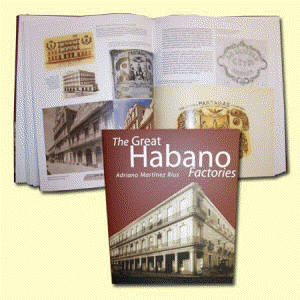
The mystique of a Cuban cigar often centers on the leaf itself, yet the true magic lies in the historic institutions where these tobacco leaves are transformed into world-renowned Habanos. Capturing the essence of this industrial heritage requires more than just a casual observer; it demands a historian with direct access to the vaults of the industry. This is precisely what readers encounter in a landmark volume authored by Adriano Martinez Rius, a text that serves as a comprehensive bridge between the golden age of Cuban tobacco and the modern era of global appreciation.
The Authority Behind the Text
What elevates a reference book from interesting to essential is the pedigree of its author. Martinez Rius is not merely a historian looking in from the outside; he is a veteran of the industry itself. Having served as a consultant for both Cubatabaco and Habanos SA up until his retirement, he possesses a depth of institutional knowledge that few can rival. His insider status provided him with the keys to unlock archives and corporate memory that remain closed to the average researcher.
This level of access is evident on every page. Furthermore, his reputation for scholarly rigor was cemented through his collaboration with Min Ron Nee, serving as an honorary consultant on the acclaimed An Illustrated Encyclopaedia of Post-Revolutionary Havana Cigars. This background ensures that the information presented is not just accurate, but deeply contextualized within the framework of Cuban economic and industrial history.
A Visual and Physical Artifact
Released initially in Spanish in 2004 before seeing its English translation the following year, the physical manifestation of the book reflects the prestige of its subject matter. It is a substantial hardcover edition, comprised of 223 pages printed on high-grade paper stock. The dimensions are generous, spanning 290mm by 240mm, a large format that allows for the grand presentation of visual materials.
Unlike text-heavy academic treatises, this volume relies heavily on visual storytelling. The pages are filled with full-color reproductions, including a vast array of photographs and historical lithographic images. These visuals do more than merely decorate the text; they transport the reader directly into the factories, offering a rare glimpse at the architecture and atmosphere of Cuba’s most revered manufacturing spaces.
Mapping the History of Production
The core ambition of Martinez Rius’s work is to document the physical and corporate lineage of Cuba’s cigar factories. This is a task of immense complexity, requiring the tracing of ownership histories and physical locations across centuries of change. The author approaches this with a detective’s eye, piecing together the movements of the industry’s major players.
- Facility Histories: Detailed accounts of the major Habanos manufacturing plants and their specific locations.
- Corporate Lineage: A clear mapping of how ownership and management have shifted over time.
- Regional Development: An exploration of how different Cuban provinces developed their own distinct cigar industries.
By expanding the scope beyond just the famous Havana brands to include regional histories, the book provides a holistic view of the island's tobacco landscape. It transforms a potential coffee table book into a serious documentary record, serving as a vital resource for understanding the geographical spread of Cuban tobacco production.
An Essential Investment for Aficionados
For collectors and serious enthusiasts, this work fills a critical void in cigar literature. While many books focus on tasting notes or cigar bands, few attempt to document the "where" and "how" of the industry’s infrastructure. By chronicling the physical history of these great factories, Martinez Rius has preserved a legacy that might otherwise have been lost to time or corporate restructuring. It remains a definitive purchase for anyone looking to deepen their understanding of the Habano legacy.