
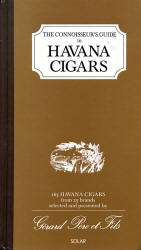
For the serious aficionado, the library of cigar literature is often filled with glossy pictorials and modern lifestyle magazines, yet there is a distinct pleasure in returning to a foundational text that captured a specific moment in tobacco history. The Connoisseur's Guide to Havana Cigars by Gérard Père et Fils stands as one such enduring volume. While originally released to the Francophone world in 1990, the work gained a broader international following through its English translation in the 1992 second edition, with a further update arriving in 1997. Today, it remains a vital artifact for those who wish to understand the evolution of Cuban tobacco over the last three decades.
_small1.jpg)
A Handsome and Practical Format
Beyond its editorial content, the physical object itself is designed with the user in mind. This substantial hardcover volume spans 256 pages, yet its dimensions—215mm by 130mm—are compact enough to make it portable. It strikes a rare balance: it is detailed enough for serious desk study but manageable enough to be carried as a field reference. The production values are immediately apparent, featuring sharp, full-color photography throughout. These images are far from mere decoration; they serve a critical documentary purpose. Readers are presented with clear visuals of finished cigars, intricate packaging designs, brand logos, and cigar bands. This visual record is indispensable for collectors attempting to verify the authenticity of vintage boxes or identify specific historical releases.
Navigating the Sections: From Field to Flame
The authors structured the book with a logical, tripartite approach that guides the reader through the entire lifecycle of the product. The first segment offers an educational deep dive into the agricultural and industrial methods behind Cuban cigar production. It demystifies the craftsmanship involved, explaining how raw tobacco leaves are transformed into finished luxury goods. The second section shifts focus to the consumer, offering practical advice on how to navigate the often-confusing marketplace. It serves as a tutorial for selection, helping the buyer make informed purchasing decisions based on their preferences.
However, the heart of the volume lies in its third and most extensive section: the tasting notes. This portion is strictly dedicated to handmade cigars, systematically evaluating them through a rigorous methodology.
A No-Nonsense Approach to Tasting Notes
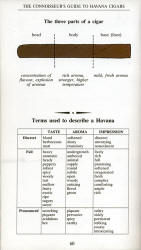
Modern cigar reviews often lean heavily into flowery metaphors and poetic descriptions, but this guide takes a decidedly different, more utilitarian tack. The authors prioritize clarity and precision over literary flourish. Each entry begins with the hard facts, outlining the cigar's physical specifications and its presentation. From there, the review methodically progresses through the smoking experience.
- Pre-Light Evaluation: Detailed notes on the initial aroma and the "cold taste" of the unlit tobacco.
- Combustion Dynamics: An analysis of the burn rate, draw resistance, and ash formation.
- Flavor Profile: A direct assessment of the lit taste and aromatic qualities, stripped of unnecessary adjectives.
- Final Verdict: A concise summary and the author's personal rating.
This stripped-down style is refreshing for the reader who seeks actionable data rather than entertainment. It delivers the essential characteristics of the smoke without bogging the user down in subjective romance.
An Invaluable Historical Record
Perhaps the most significant value of this work in the modern era is its status as a time capsule. The book effectively froze the Cuban cigar industry in the amber of the early 1990s. In the thirty years since its publication, the industry has undergone seismic shifts. Blend compositions have changed, vitolas have been discontinued, and entire brands have vanished from the marketplace. For the historian or the serious collector, this guide offers a reliable baseline. It allows for a direct comparison between the flavor profiles of the past and the modern equivalents, highlighting how specific marcas have evolved. It preserves the memory of cigars that no longer exist, making it an essential reference for anyone looking to chart the trajectory of Havana's most famous export.