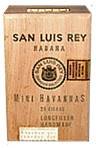
Within the vast and storied annals of Cuban tobacco, there exists a tier of vitolas that often escapes the limelight reserved for grand hand-rolled Edición Limitadas. The San Luis Rey Mini stands as a quiet testament to this overlooked category—a machine-made relic of a bygone era that offers a fascinating glimpse into the industrial side of Habanos. While the brand name San Luis Rey carries a certain prestige, often associated with fuller-bodied profile cigars, this particular iteration was designed for accessibility and brevity. Today, it exists solely in the humidors of collectors, a discontinued artifact that marks a specific moment in the production history of the island.

The Shift from Hand-Rolled to Machine-Made
The most defining characteristic of the San Luis Rey Mini is its construction. Unlike the prestigious "totalmente a mano" (totally by hand) designation sought after by purists, this cigar was a product of industrial automation. The decision to produce this format via machine was not a compromise on quality, but rather a strategic choice to ensure uniformity and availability. Machine-made cigars, often utilizing short-filler tobacco, offer a consistent draw and burn that can be difficult to achieve in such diminutive dimensions when rolled by hand.
This production method allowed the manufacturer to maintain a specific standard for a cigar that might otherwise be too delicate or time-consuming to hand-roll efficiently. By removing the human variance inherent in hand-rolling, the San Luis Rey Mini delivered a predictable experience every time. It served as a utilitarian option for smokers who desired the flavor profile of the San Luis Rey brand without the time commitment or expense of a premium hand-crafted vitola.
A Distinctive Minimalist Aesthetic
In a market saturated with elaborate bands and ornate packaging, the San Luis Rey Mini embraced a philosophy of stark simplicity. The cigar was entirely absent of a decorative band. This "naked" presentation is somewhat rare in the modern cigar world, where branding is often considered as important as the tobacco itself. The lack of a band forced the smoker to judge the cigar solely on its construction and flavor, stripping away the prestige associated with the visual brand identity.
Furthermore, the physical dimensions of the cigar reinforced its minimalist intent. It featured a slender ring gauge of 19 and a length of 82 millimeters (approximately 3¼ inches). These measurements classify the cigar as a "Mini," a format designed for a brief smoking session. The official factory name for this vitola was simply "Mini," a straightforward title that left no room for misinterpretation regarding its size or intent.
Packaging and Market Positioning
During its time in regular production, the San Luis Rey Mini was offered to consumers through two distinct packaging avenues, though both contained the same quantity of cigars. Smokers could purchase the product in a standard cardboard pack containing 20 units. This format was ideal for the casual consumer or the traveler, offering a lightweight and cost-effective way to access the brand.
Alternatively, the cigar was available in a traditional boîte nature—a natural wood box—also holding 20 cigars. This wooden box option provided a more classic aesthetic, appealing to those who appreciated the traditional rituals of cigar collecting, even if the cigars inside were machine-made. This dual-packaging strategy highlighted the brand's intent to straddle the line between convenience and tradition.
The Legacy of a Discontinued Format
Since being removed from regular production, the San Luis Rey Mini has transitioned from a consumer product to a collector's item. Its discontinuation reflects a broader trend in the industry, where the demand for machine-made miniatures has fluctuated while the appetite for premium hand-rolled cigars has remained robust. For historians of Habanos, the Mini serves as an important footnote, demonstrating the diversity of the Cuban cigar portfolio beyond the famous Churchill and Robusto sizes.
While it may lack the complexity or aging potential of its larger, hand-rolled brethren, the San Luis Rey Mini remains a curious piece of the puzzle. It stands as a reminder that the Cuban cigar industry has always been multifaceted, capable of producing both artisanal masterpieces and efficient, everyday smokes. For those lucky enough to find a well-preserved box today, the cigar offers a fleeting taste of a brand that has largely exited the miniature market, preserving its memory in tobacco and wood.