When it comes to iconic Cuban cigar brands, Romeo y Julieta stands out for its rich heritage and diverse portfolio. Among its many vitolas, the Club Kings (2) holds a special place as a long‑running, machine‑made option that introduced countless smokers to the brand’s characteristic flavor without the price tag of hand‑crafted cigars. This compact smoke, often overlooked in modern discussions, tells a compelling story of accessibility, durability, and the evolving tastes of the 20th‑century cigar market.

Origins and Historical Significance
The Club Kings (2) traces its roots to the pre‑1960 era, making it one of the earliest releases in the Romeo y Julieta catalog. Designed as an entry point for both novice and budget‑conscious aficionados, the vitola was produced continuously for several decades. Its production run finally came to a close in the 1980s, marking the end of an era for a cigar that once filled the shelves of tobacconists worldwide. The brand’s decision to keep this vitola in regular production for so long underscores its commitment to offering a consistent, quality experience at an affordable price.
Technical Specifications
Understanding the Club Kings (2) means looking at its precise dimensions and build. In the factory, this vitola is referred to as the Petit Coronas, a name that reflects its modest size within the Romeo y Julieta lineup. Below are the key measurements:
- Factory Name: Petit Coronas
- Ring Gauge: 42
- Length: 129 mm (approximately 5 ⅛ inches)
- Official Weight: 8.46 g
- Construction Method: Machine‑made
- Band Style: Standard “A” band
These specifications highlight a cigar that strikes a balance between portability and smoking time, delivering a moderate draw and a steady burn that appeals to those seeking a reliable, everyday smoke.
Construction and Visual Design
As a machine‑made cigar, the Club Kings (2) was engineered for uniformity across each stick. The use of mechanized rolling ensured that every cigar shared the same core dimensions, filler blend, and wrapper tension, resulting in a predictable flavor profile that seldom deviated from one batch to the next. The classic “A” band, rendered in the brand’s signature colors, ties the vitola visually to the rest of the Romeo y Julieta range, reinforcing brand identity even at a lower price point. The wrapper, while not a rare aged leaf, still offered a smooth, slightly oily surface that contributed to a mellow smoking experience.
Packaging and Market Presence
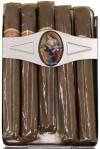
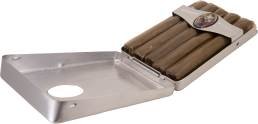
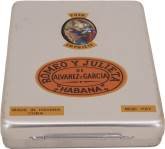
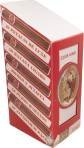
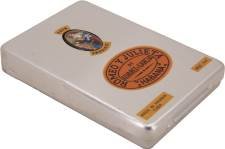
During its commercial life, the Club Kings (2) was packaged in a manner that combined practicality with product protection. Each display box contained 50 cigars, which were subdivided into 10 aluminum foil packs of five cigars each. This packaging strategy served multiple purposes: the aluminum wrappers shielded the cigars from humidity fluctuations and physical shock, making them suitable for travel or retail display, while the smaller packs allowed consumers to purchase a modest quantity without committing to an entire box. The result was a product that was both convenient for the smoker and efficient for the retailer.
Legacy and Collectibility
Although production ceased in the 1980s, the Romeo y Julieta Club Kings (2) endures in the annals of Cuban cigar history. Today, it is sought after by collectors and historians who appreciate its role in democratizing premium tobacco. Its decades‑long availability made it a common sight in the mid‑20th‑century humidor, and its discontinuation marks a shift toward a market that increasingly favors hand‑crafted premium cigars. For those exploring vintage Cuban smokes, the Club Kings (2) offers a tangible link to an era when machine‑made cigars played a crucial role in spreading the love of Cuban tobacco across the globe.