Within the vast and storied archives of Habanos, certain names echo with a resonance that transcends mere tobacco. The Por Larrañaga Picadores is one such name, a cigar that has long since vanished from store shelves yet remains firmly etched in the annals of connoisseur history. It serves as a tangible link to a pivotal moment in time, representing a bridge between the privately owned cigar factories of old Cuba and the state-run industry that emerged in the latter half of the 20th century. For the modern enthusiast, the Picadores is not simply a discontinued smoke; it is a relic of a transformative epoch.

A Witness to Revolution and Change
The timeline of the Picadores is what grants it such unique historical weight. Originally released prior to 1960, this cigar entered the market during the final years of the pre-revolutionary era. It was a time when the Cuban cigar landscape was dominated by private family dynasties, and the Picadores was a standard bearer for the Por Larrañaga brand during that golden age.
However, the true test of its endurance came with the nationalization of the tobacco industry. While many brands and specific vitolas were lost to the upheaval of the early 1960s, the Picadores demonstrated resilience. It successfully transitioned into the new state-controlled production model, continuing to be manufactured well into the early years of the revolutionary government. This duality makes it a fascinating subject for historians: a cigar born of one system that survived long enough to operate within another. Its journey eventually concluded in the 1970s, when production ceased, sealing its status as a collectible artifact.
The Mareva Dimensions and Construction
At the heart of the Picadores' appeal was its specific format, which fell squarely into the Mareva category. This classification is often revered for its mathematical balance, offering a smoking experience that is neither too brief nor overly demanding. The cigar measured a precise 127 millimeters (approximately 5 inches) in length, with a ring gauge of 44. These dimensions suggest a smoke that was substantial enough to allow the complexities of the Cuban tobacco to unfold, yet approachable enough for a standard evening session.
According to surviving records, the construction was entirely handmade—a hallmark of premium Cuban production during that era. The official weight of the Picadores was recorded at 8.86 grams, a figure that indicates a dense, solid fill. Unlike the machine-made cigars that would proliferate in later decades, this vitola relied on the skilled hands of a torcedor to ensure the proper draw and burn. The result was a cigar that embodied the artisanal standards of its time, wrapped in a leaf that carried the distinct terroir of the island.
Visual Identity and Presentation
In the world of cigars, presentation is nearly as vital as the smoke itself. The Picadores was distinct within the Por Larrañaga portfolio for featuring a special band. While the specific design details are often debated by collectors, the presence of this unique branding signaled that the cigar was a flagship offering, meant to stand out from the regular lineup.
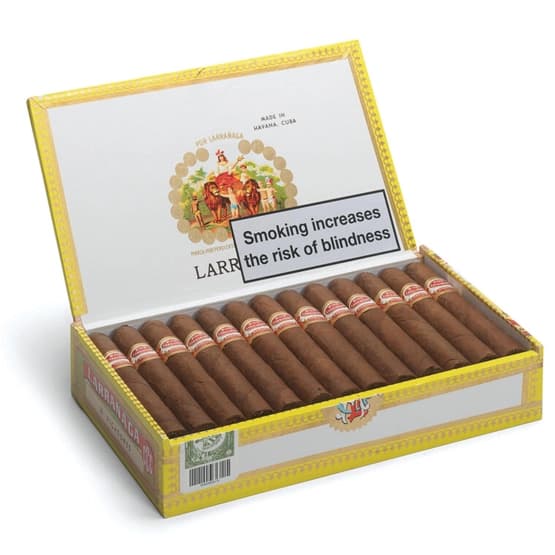
The packaging adhered to the traditional aesthetics valued by serious smokers of the period. The cigars were housed in dress boxes of 25, a presentation style that emphasized elegance and order. This format not only protected the cigars but also added a sense of occasion to the purchase, reinforcing the idea that the Picadores was a product intended for the discerning palate.
The Legacy of a Discontinued Classic
Since its discontinuation in the 1970s, the Por Larrañaga Picadores has drifted into the realm of the unobtainable. It exists today solely as a collector's item, a dusty box discovered in a humidors of a bygone generation, or a listing in an auction catalog. The end of its production run marked the close of a specific chapter for Por Larrañaga, a brand that has continued to evolve long after the Picadores departed.
For those who study the evolution of Habanos, this particular vitola remains a critical reference point. It illustrates the shifting tides of Cuban manufacturing capabilities and consumer tastes over the decades. While the Picadores can no longer be purchased at a local tobacconist, its memory serves as a reminder of the rich, layered history that defines the Cuban cigar industry—a history built as much on the cigars that disappeared as on those that remain.