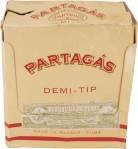
In the evolving landscape of Cuban tobacco, where tradition and handcrafting are revered above all else, the Partagás Demi Tip stands as a unique anomaly. It serves as a historical marker for a bygone era, representing the final vestige of a specific manufacturing approach that prioritized convenience over ritual. While modern aficionados obsess over the perfect cut and the intricate ritual of lighting a handmade vitola, the Demi Tip offered a starkly different experience—one defined by automation and ease. This cigar holds a distinct place in the Partagás catalog not merely for its flavor profile, but for its hardware: it was the very last Cuban Habano to be fitted with a plastic mouthpiece before the practice was entirely phased out.

A Relic of Pre-Revolutionary Industry
The origins of the Demi Tip trace back to a time before the Cuban Revolution fundamentally altered the island's cigar industry. Initially released prior to 1960, the brand enjoyed a lengthy lifespan that bridged the gap between the pre-revolutionary private sector and the state-run monopoly that followed. Its survival well into the post-revolutionary era speaks to its sustained popularity among local consumers and tourists alike.
However, like many machine-made vitolas of its time, its lifespan was not infinite. Production continued for decades, but the changing tides of the global cigar market eventually caught up with it. By the 1980s, the decision was made to discontinue the line, effectively closing the chapter on plastic-tipped Cubans. This discontinuation marked a significant shift in the philosophy of Habanos S.A., moving away from industrial convenience features toward the premium, hand-rolled image the island promotes today.
Technical Specifications and Construction
The Partagás Demi Tip was defined by a specific set of dimensions that categorized it as a manageable, everyday smoke. Unlike the massive Robustos or Double Coronas favored by enthusiasts today, this vitola was slender and modest.
- Vitola Size: Measuring 126 mm (approximately 5 inches) in length with a slim ring gauge of 29, the cigar offered a quick, focused smoking experience.
- Manufacturing Method: Unlike the premium hand-rolled cigars Partagás is famous for, the Demi Tip was a machine-made product. This automated construction ensured uniformity and allowed for a lower price point, making it an accessible entry point for new smokers.
- The Plastic Tip: The defining feature was, of course, the integrated plastic mouthpiece. This addition eliminated the need for a cutter or a punch, allowing the smoker to ignite the cigar immediately after taking it out of the package.
The factory designation remained simply "Demi Tip," and each unit carried an official weight of roughly 3.68 grams. It was wrapped in the standard Partagás band, familiar to fans of the brand’s richer, fuller-bodied offerings, though the smoking experience was considerably lighter due to the machine-bunched filler.
Packaging and Presentation
Reflecting its positioning as an accessible, regular production item, the Demi Tip was offered in practical packaging configurations designed for consumption rather than long-term aging. The industry standard for this vitola included two main options for consumers:
The first was a modest cardboard pack containing five cigars. For those seeking a larger quantity, a standard dress box containing 25 cigars was also available. In both formats, individual cigars were encased in cellophane, a protective measure that preserved the tobacco's condition and further emphasized the "grab-and-go" nature of the product.
The End of an Era
The discontinuation of the Partagás Demi Tip in the 1980s was more than just a catalog adjustment; it was a symbolic turning point. For decades, plastic tips were a common sight in the Cuban market, bridging the gap between cigarettes and premium cigars. They offered a no-nonsense smoking experience that appealed to a demographic less interested in the ceremonial aspects of cigar smoking.
When the Demi Tip vanished from shelves, it signaled that the era of convenience-focused Habanos had truly ended. No longer would a smoker find a Cuban product that required zero preparation. This shift forced the market to embrace the tools of the trade—cutters, lighters, and humidors—cementing the modern image of the cigar smoker as a connoisseur of craft.
Today, the Demi Tip survives only in the collections of dedicated historians and vintage tobacco hunters. It remains a fascinating footnote in the legacy of the Partagás brand, reminding us that Cuban cigar history is not just about the handmade masterpieces, but also the industrial innovations that once served the masses.