
For the discerning aficionado, the allure of a vintage Cuban cigar extends far beyond the tobacco contained within; it is deeply rooted in the visual heritage of the brand. Among the pantheon of historical Cuban labels, the María Guerrero brand occupies a distinguished place, offering a tangible link to the golden age of habanos. The brand’s packaging, particularly its cigar bands, serves as a historical archive, documenting the evolution of industrial design and quality standards from the pre-revolutionary era through the late 20th century. For historians and collectors alike, decoding these paper rings is essential for verifying authenticity and understanding the provenance of a given box.
The Primary Standard: A Quarter-Century of Design
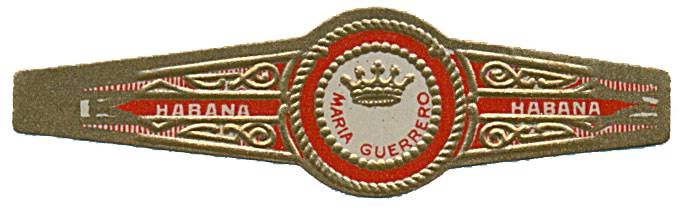
The most ubiquitous emblem associated with the María Guerrero name is the primary standard band, a design that anchored the brand’s visual identity for decades. This specific label enjoyed a remarkable production run, originating in the years prior to 1960 and remaining in active use until approximately 1985. Such longevity makes it one of the most reliable markers for collectors dating vintage inventory from the latter half of the century.
What sets this particular band apart from lesser productions of the time is the distinct quality of its manufacturing. Unlike the flat, lifeless prints found on modern machine-rolled variants, these vintage bands were characterized by a sophisticated embossing technique. The raised relief on the paper was not merely decorative; it was a deliberate signal of the brand’s premium positioning. Collectors hunting for specimens from this era specifically look for this texture, as it serves as a primary indicator of a genuine, pre-1985 product.
Elevating the Machine-Made Aesthetic
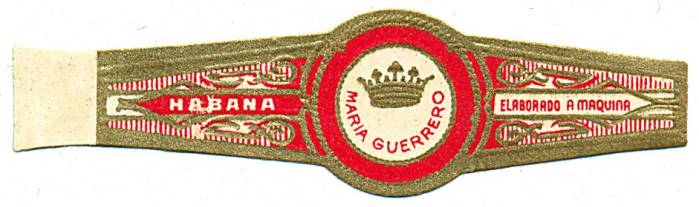
While hand-rolled cigars often receive the lion's share of attention regarding presentation, María Guerrero maintained a surprising consistency across its production lines. Even the brand’s machine-made cigars, produced during earlier periods, were adorned with bands that refused to compromise on quality. These "classic" labels mirrored the aesthetic ambition of their hand-finished counterparts, incorporating the same precise embossing that defined the brand's premium offerings.
This attention to detail is significant because it highlights a different philosophy in the Cuban cigar industry’s history—a time when machine manufacturing did not necessarily equate to a disregard for luxury presentation. The embossed bands on these machine-made vitolas helped the products stand out in a crowded marketplace, ensuring that the María Guerrero name commanded respect regardless of how the tobacco was rolled. Today, finding these machine-made bands with intact embossing remains a rewarding challenge for collectors focused on industrial cigar history.
The Elusive Londres Customization
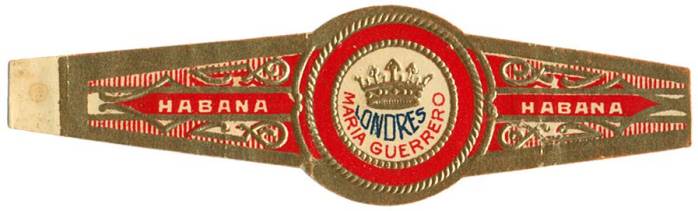
Perhaps the most intriguing chapter in the brand’s packaging history involves a specialized band created for the Londres vitola. This particular format required a custom design, distinct from the standard issue, yet it retained the signature embossed finish that collectors prize. However, the lifespan of this specific label was surprisingly brief.
Production of this custom band ceased well before the standard band was retired, with sources indicating it was discontinued prior to 1975. Consequently, surviving examples are significantly scarcer than the standard bands that remained in production for another decade. For the serious collector, stumbling upon a box of María Guerrero Londres cigars with this specific custom band intact is a rare opportunity. The limited production window creates a distinct scarcity, making these bands a high-value target for authentication and acquisition.
Authenticating the Past
The study of María Guerrero bands offers more than just aesthetic pleasure; it provides a practical roadmap for authentication. The transition from embossed, high-relief printing to flatter designs serves as a chronological benchmark for dating vintage boxes. Because the custom Londres band vanished from shelves years before the standard band was retired, finding one is an immediate indicator of specific production eras.
- Standard Production Band: Identified by its embossed texture and active production from the pre-1960 era until roughly 1985.
- Machine-Made Classic: Features similar embossing quality, distinguishing early machine-rolled products from later, lower-quality prints.
- Londres Custom Band: The rarest variant, discontinued pre-1975, making it a key artifact for dating specific vintage collections.
Ultimately, the legacy of María Guerrero is written in these paper rings. The brand's steadfast commitment to embossed detailing across all lines—from standard to custom, hand-rolled to machine-made—demonstrates a level of craftsmanship that modern productions rarely emulate. For the modern enthusiast, recognizing these nuances is the key to unlocking the history of a truly legendary Cuban name.