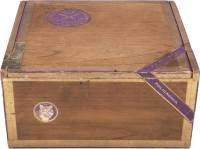
For the discerning aficionado, few pursuits are as rewarding as uncovering the specific histories tied to regional releases and exclusive house brands. Among the most intriguing of these historical artifacts is the La Corona Policromia Purple, a cigar that serves as a tangible reminder of the intricate commercial relationships that once existed between Havana's bustling factories and prestigious international tobacconists. Commissioned specifically for the renowned J. J. Fox, this smoke is far more than a simple consumable; it is a relic from a golden age of Cuban tobacco production that has since vanished into history.


A Product of Its Time: The Historical Context
The story of the Policromia Purple begins in 1960, a year that marked a watershed moment in the global cigar industry. Launched during a period of immense transformation within Cuba, this cigar entered the market as a regular production item, though its lifespan would ultimately prove finite. It remained on shelves for roughly two decades before production ceased entirely during the 1980s. This timeline places the cigar squarely in an era where traditional manufacturing methods met shifting geopolitical landscapes, resulting in a collectible that bridges the gap between the pre-embargo golden age and the later state-run tobacco industry.
What makes this release particularly notable is its status as a J. J. Fox exclusive. This designation highlights a practice that was once common but has now become rare: the creation of specific vitolas for singular retailers. It demonstrates the level of influence held by major merchants like J. J. Fox, who could dictate specific blends and presentations directly to the Cuban manufacturers. Today, surviving examples offer a window into that collaborative past, showcasing a level of bespoke craftsmanship that modern production rarely replicates.
The Evolution of Branding and Identity
One of the most fascinating aspects of the Policromia Purple lies in its packaging evolution, which provides a roadmap for collectors attempting to date vintage boxes. The cigar’s presentation was not static; it underwent a significant transformation during its production run that mirrored broader changes within the Cuban cigar hierarchy.
Originally, the cigars featured a dual-band presentation. Smokers would find the standard La Corona Policromia band sitting alongside a distinct secondary band in purple. This double-band style identified the cigar immediately as a special release. However, the 1970s brought a streamlining of this identity. The presentation was simplified to a single band reading "Poli-cromia Purple."
This change was not merely cosmetic. It reflected a strategic shift in the late 1970s where the Policromia line graduated from being a sub-brand under the La Corona umbrella to standing as an independent marque. For the collector, the distinction between the early dual-band format and the later single-band version is crucial, offering a clear visual indicator of the cigar's production era.
Technical Specifications and Dimensions
Beyond its history, the La Corona Policromia Purple is distinguished by its physical attributes. While precise measurements can vary slightly due to the nature of hand-rolled tobacco and the passage of time, the standardized specifications provide a clear picture of the smoking experience intended by the creators.
- Dimensions: The cigar measures 163 mm (approximately 6⅜ inches) in length with a ring gauge of 44. This size situates the smoke comfortably within the Corona family, though its specific proportions were tailored uniquely for this exclusive release.
- Construction: True to the traditions of the era, these were entirely handmade products, ensuring a complexity of flavor that machine-made alternatives could not achieve.
- Packaging: The cigars were presented in dress boxes of 25, a classic configuration that allowed for elegant display and aging potential.
- Weight: The estimated weight of an individual stick is roughly 9.86 grams, a figure derived from the analysis of surviving inventory.
It is important for enthusiasts to recognize that the dimensional data available today is often reconstructed from surviving vintage samples. Consequently, slight variances may exist, which is a common characteristic of handmade goods from this period.
Collectibility and Modern Significance
In the current landscape of fine tobacco, the Policromia Purple represents a significant "get" for serious archivists and collectors. Because the line was discontinued decades ago and was originally produced exclusively for a single retailer, availability is extremely limited. Finding a well-preserved box is akin to uncovering a piece of lost commercial art.
The shifting branding elements—from the dual-band inception to the streamlined single-band conclusion—add layers of nuance to the collecting process. These variations allow historians to trace the marketing evolution of Cuban cigars during a pivotal transitional era. For those lucky enough to encounter one, the La Corona Policromia Purple offers more than just a smoke; it offers a sensory connection to the mid-20th century and the enduring legacy of J. J. Fox's influence on the global cigar trade.