Among the pantheon of coveted Cuban cigars that have become treasured relics of tobacco history, the J.J. Fox La Corona Policromia Blue stands as a remarkable artifact from an era when Cuban cigar production was undergoing significant transformation. This exclusive release, crafted specifically for one of the most prestigious retailers in the cigar world, embodies the craftsmanship and mystique that continue to captivate collectors and enthusiasts decades after its final production run concluded. Understanding the story behind this discontinued vitola reveals much about the evolution of Cuban cigar branding, manufacturing practices, and the enduring appeal of vintage habanos.


The Origins and Exclusive Nature
The Policromia Blue emerged as a distinctive offering within the storied Policromia line, representing a collaborative effort between the renowned J.J. Fox tobacconist and Cuban manufacturers during the mid-twentieth century. Unlike mass-produced cigars of its era, this particular vitola was conceived as an exclusive release, destined primarily for the shelves of J.J. Fox's establishment. This exclusivity contributed to its relative scarcity even during its active production years, and today surviving specimens have become genuinely rare commodities in the vintage cigar marketplace. The partnership between retailer and manufacturer resulted in a cigar that carried the distinctive character of the Policromia lineage while bearing the imprimatur of one of the most respected names in premium tobacco retail.
Technical Specifications and Construction
The physical characteristics of the Policromia Blue reflect the standards of Cuban cigar production during its manufacturing period. The vitola measures approximately 128 millimeters in length, which translates to roughly five inches, presenting as a modest but satisfying smoking experience. The ring gauge of 44 millimeters positions this cigar within the classic petit corona category, offering a concentrated flavor profile in a relatively compact format. Analytical examination of surviving examples suggests an estimated weight of 7.74 grams, indicating a densely packed interior that would have provided a consistent, fulfilling smoke. The construction methodology was entirely handmade, utilizing traditional techniques that skilled Cuban torcedores employed to create these precisely crafted smoking instruments. While the specific factory responsible for production remains unidentified in available records, the quality of construction suggests production at a facility equipped to handle specialized exclusive orders.
Packaging and Visual Presentation
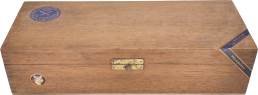
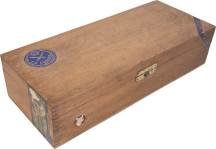
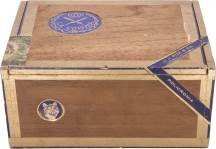
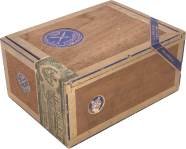
The Policromia Blue reached consumers through two distinct packaging configurations that catered to different market preferences. The more common presentation consisted of dress boxes containing 25 individual cigars, providing an accessible quantity for personal enjoyment or modest gifting purposes. For collectors and merchants seeking larger quantities, a more substantial option existed in the form of boîte nature boxes, which housed 100 cigars per container. This variety in packaging options reflects the marketing strategies employed during the cigars active commercial life, allowing retailers to accommodate diverse customer needs while maintaining the exclusive character of the product. The boxes themselves bore the distinctive branding associated with the Policromia line, though as production evolved, the visual presentation underwent notable modifications that now serve as important dating indicators for collectors.
Branding Evolution and Historical Context
One of the most intriguing aspects of the Policromia Blue's history involves the evolution of its visual identity through various production phases. During the earliest period of manufacture, these cigars featured a dual-band presentation, combining the standard La Corona Policromia band with an auxiliary blue band that contributed to the cigars distinctive appearance. This two-band configuration served as an early identifier of the original production era. However, a significant simplification occurred during the 1970s when the presentation was streamlined to feature only the Poli-cromia Blue band, eliminating the secondary identification. Perhaps more substantially, the late 1970s witnessed a fundamental rebranding transition as the Policromia line departed from its association with the La Corona marque, emerging instead as an independent label. This meant that subsequent production runs carried exclusively Poli-cromia branding, severing the connection to the parent La Corona identity that had characterized earlier releases.
Production Timeline and Modern Significance
The Policromia Blue first entered the marketplace prior to 1960, placing its introduction firmly within the pre-revolutionary period of Cuban cigar production. This timing is crucial for understanding the cigars place in tobacco history, as it represents an artifact from the final years before the dramatic changes that followed the Cuban Revolution altered the landscape of cigar manufacturing on the island. Production continued for approximately two decades before the line was ultimately discontinued during the 1980s, bringing an end to an era of exclusive retail partnerships that had produced some of the most sought-after vintageCuban cigars. Today, the surviving examples of the Policromia Blue represent genuine collector's items, treasured not only for their smoking qualities but also as tangible connections to a pivotal chapter in the annals of premium cigar history.