Among the distinguished portfolio of Cuban cigars, few vitolas have achieved the timeless appeal of the H. Upmann Magnum 46. This Corona Gordas format has maintained its presence in humidors worldwide for over six decades, embodying the essence of what makes Cuban tobacco craftsmanship so revered. Whether you're a seasoned aficionado or exploring the world of premium cigars for the first time, the Magnum 46 offers a smoking experience that bridges tradition and contemporary taste.

A Legacy Forged Before 1960
The origins of the Magnum 46 trace back to an era when Cuban cigar makers were perfecting their art in the heart of Havana. This particular vitola was introduced well before 1960, making it one of the oldest continuously produced formats in the H. Upmann lineup. The brand itself carries a prestigious heritage, having supplied cigars to heads of state and dignitaries throughout its storied past. The Magnum 46 represents the culmination of generations of tobacco expertise, maintaining the same core characteristics that first won over smokers decades ago. Its enduring production speaks to the consistent quality and unmistakable character that enthusiasts have come to expect from this historic marque.
Physical Specifications
The Magnum 46 presents itself in the Corona Gordas format, a size that has become synonymous with balanced smoking experiences. The following specifications define this vitola:
- Ring Gauge: 46
- Length: 143 millimeters (5⅝ inches)
- Official Weight: 11.41 grams
- Construction: Handmade
- Production Status: Current regular production
The dimensions of this cigar provide an ideal canvas for the complex interplay of flavors that Cuban tobacco delivers. The 46-ring gauge allows for adequate airflow while maintaining sufficient tobacco mass to develop nuanced taste profiles throughout the smoking journey.
Presentation and Packaging Evolution
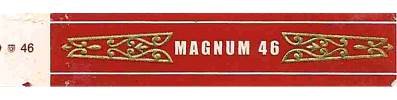
Throughout its history, the Magnum 46 has undergone notable changes in how it reaches consumers. Initially, this cigar was sold without any decorative bands, a common practice in earlier decades. Around the mid-2000s, specifically between 2005 and 2008, standard H. Upmann bands labeled A, B, or C began adorning the vitola. The modern era brought additional refinement when, starting approximately in 2008, the standard band C became standard issue, complemented by a distinctive secondary band created specifically for the Magnum 46. This dual-banding approach elevated the visual presentation and made the cigar instantly recognizable among collectors.
Protection and presentation received further enhancement with the introduction of aluminum tubes around 2009. Current packaging options include display boxes containing 15 aluminum-tubed cigars, organized into five cardboard packs of three each. The classic slide lid box of 25 units remains in active production, while the larger 50-count slide lid box was officially discontinued in 2012, though some dated examples surfaced as late as May 2014. The three-pack cardboard format, which served as a popular retail option, was discontinued around 2009.
A notable special edition emerged in 2010, when a limited ceramic jar containing 30 Magnum 46 cigars was produced exclusively for Western European markets. This collector's item quickly gained recognition among enthusiasts seeking rare expressions of this beloved vitola.
Tasting Experience and Flavor Profile
Based on extensive consumer feedback encompassing 67 reviews, the Magnum 46 achieves a respectable overall rating of 3.7 out of 5 stars. Individual category scores consistently land at 3 across elegance, balance, strength, complexity, and aftertaste, indicating a well-proportioned smoking experience without extreme characteristics in any single dimension.
This medium-bodied offering delivers a sophisticated journey through multiple flavor planes. The most frequently cited notes include buttery shortbread and rich coffee, creating a comforting foundation that appeals to a broad range of palates. These primary flavors are skillfully interwoven with touches of cedar and subtle licorice, adding depth and character. Reviewers have also reported supporting notes of creamy tobacco, that distinctive Cuban twang that signals authentic Habanos, earthen fruitiness, leather undertones, pepper accents, woody elements, and occasional nutty or spicy dimensions. The complexity emerges gradually, rewarding patient smokers who allow the cigar to express its full range as the burn line progresses.