
In the shifting landscape of premium tobacco, few subjects provoke as much nostalgia as the defunct Cuban lines of the late twentieth century. Among these departed legends sits the Dunhill Mojito, a cigar that serves as a tangible reminder of a unique commercial era. It was a time when the prestigious British luxury house Dunhill lent its name to Cuban tobacco, creating products that blended London sophistication with Havana’s rich agricultural heritage. Though no longer rolling off the production lines, this specific vitola remains a point of fascination for collectors who seek to understand the evolution of the modern cigar industry.

A Unique Anglo-Cuban Alliance
The existence of the Mojito is entirely due to a licensing agreement that seems almost foreign to today's market dynamics. For a significant portion of the 1980s, the British luxury retailer collaborated directly with Habanos S.A. to produce authentic Cuban cigars bearing the Dunhill insignia. This partnership allowed for a fusion of branding philosophies, resulting in cigars that were marketed as accessible luxury items rather than unobtainable rarities.
The Mojito entered the global market in 1982, establishing itself as a core offering rather than a limited edition or regional special release. It enjoyed a respectable lifespan as a regular production item, satisfying smokers for nearly a decade. However, the curtain fell on this specific model in 1991 when production officially ceased. This discontinuation marked the end of an era, transforming the cigar from a shelf staple into a piece of tobacciana history.
Vitola Specifications and Smoking Profile
True to the traditional standards of the time, the Mojito was constructed using the Coronas vitola format. This size is often cited as the benchmark for judging a tobacco’s flavor profile, offering a ratio of length to girth that allows the leaf characteristics to shine without being overwhelmed by the burn of the wrapper or the concentration of the filler.
The physical dimensions of the cigar placed it squarely in the medium-bodied category of the time. With a length of 142mm (approximately 5⅝ inches) and a ring gauge of 42, it provided a substantial yet manageable experience. Smokers of the era could expect a session to last anywhere from thirty to forty-five minutes, making it an ideal choice for a mid-day respite or an evening interlude.

Technical Details
- Factory Name: Coronas
- Dimensions: 142mm x 42 Ring Gauge
- Official Weight: 9.29g
- Construction: Handmade
Every unit was entirely handmade by skilled torcedores, reflecting the labor-intensive craftsmanship that defined Cuban manufacturing during the period. It was finished with the Standard band A, a minimalist design that signaled the understated elegance associated with the brand.
Presentation and Packaging Varieties
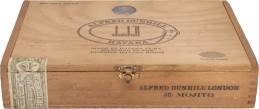
Reflecting its position as a premium consumer good, the Mojito was offered in distinct packaging styles designed to appeal to different buyer preferences. The first option was the semi boîte nature box, which contained 25 cigars. This style utilized a sliding lid and natural wood construction, a presentation favored by traditionalists for its breathability and classic aesthetic.
Alternatively, consumers could purchase the dress box of 25 cigars. This format offered a more polished and refined appearance, often chosen for gifting purposes or for collectors who preferred a more decorative storage solution. Both options reinforced the brand’s identity as a luxury product, ensuring that the unboxing experience matched the quality of the tobacco inside.
The Enduring Legacy
Since its disappearance from retail shelves over three decades ago, the Dunhill Mojito has transitioned from a consumer product to a collector's item. It stands as a symbol of the Dunhill-Habanos collaboration, a relationship that produced distinctive cigars that are now increasingly difficult to source. For the modern enthusiast, finding a well-preserved Mojito offers a rare glimpse into the flavor profiles and construction techniques of the 1980s. As stocks dwindle and time passes, the remaining examples serve as historical artifacts, preserving the memory of a distinctive period when British marketing met Cuban mastery.