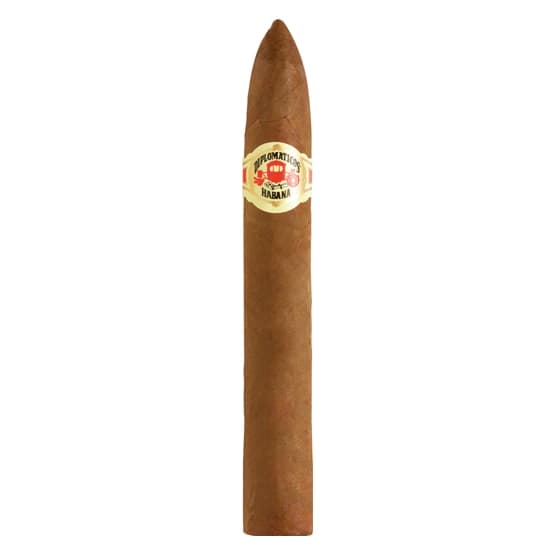
When a cigar disappears after only a handful of years yet continues to attract seasoned smokers and historians alike, there’s usually a story worth savoring. The Diplomáticos No.7 is one of those stories—a concise, hand‑crafted vitola that slipped onto the market in the mid‑1970s, lingered for a brief window, and then vanished, leaving behind a whisper of intrigue that has only grown louder with time.

A Brief but Impactful Debut (1976‑Early 1980s)
Launched in 1976, the No.7 arrived at a pivotal moment for Cuban cigar makers, who were refining their blends and expanding export reach. For roughly five to seven years—until the early part of the 1980s—the cigar was produced as a regular, mainstream offering, giving aficionados a reliable, mid‑range experience that was distinct from the brand’s more famous Montecristo siblings. Its relatively short lifespan has turned the No.7 into a rarity; the brand never reissued it, cementing its status as a limited‑run classic.
Inside the Vitola: Size, Construction, and Factory
The No.7 is built around a slender 152 mm (6 inches) long chassis with a ring gauge of 38. Weighing in at 8.15 g, it is entirely handmade, a testament to the meticulous labor of Cuba’s most seasoned torcedors. Each stick bears the factory designation Laguito No.2, a name synonymous with prestige in the island’s cigar‑making hierarchy. That association adds a layer of pedigree, as the Laguito facility is known for crafting many of the country’s most celebrated premium cigars.
Packaging Options Through the Years
During its run, the No.7 was presented in several distinct formats, reflecting the brand’s ambition to reach different consumer preferences:
- Dress box of 25 cigars – introduced toward the end of the 1970s, discontinued when the line ended in the early 1980s.
- Semi‑boîte nature box of 10 cigars – released in 1976 and phased out by the late 1970s.
- Semi‑boîte nature box of 25 cigars – also launched in 1976, with its production ceasing by the late 1970s.
- Humidor of 100 cigars – a larger, more communal presentation that catered to retailers and serious collectors.
This variety allowed the No.7 to appear on shop shelves in both intimate and bulk configurations, a flexibility that further heightened its appeal.
Why the No.7 Remains a Collector’s Prize
Because the No.7 was a standard‑production release that was ultimately discontinued, its supply is finite. The cigar’s production window—spanning only a few years—means that any surviving boxes or individual sticks are now coveted pieces of history. Collectors seeking to assemble a comprehensive Diplomáticos archive often list the No.7 as a must‑have, especially when they can verify its provenance via the Laguito No.2 factory stamp. Beyond the brand’s lore, the vitola itself is appreciated for its balanced profile: a medium‑strength blend that showcases the classic Cuban terroir of earth, cedar, and subtle spice.
For those who manage to locate an aged specimen, the experience can be reminiscent of tasting a time capsule—each draw offering a glimpse of the Cuban cigar culture that flourished in the late 1970s. The No.7’s story is a reminder that sometimes, the most memorable cigars are not the longest‑lived, but the ones that leave a lasting imprint on the palate and the imagination.