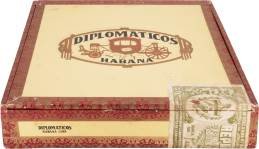
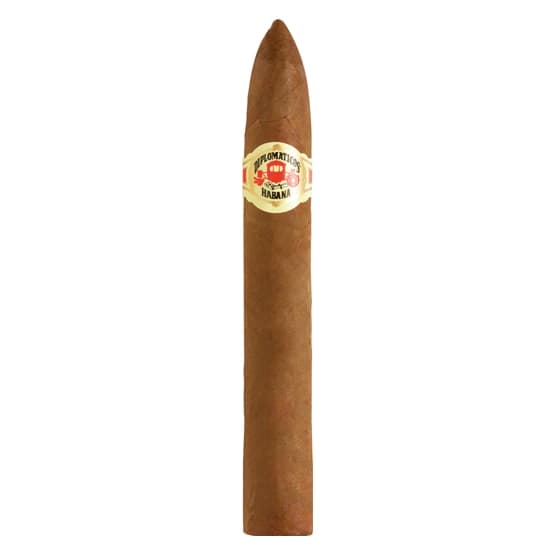
In the exclusive world of premium Habanos, few subjects spark as much intrigue as a cigar that has vanished from production. The Diplomáticos No.6 stands as a prime example of this phenomenon—a vitola that graced the market for only a fleeting moment before disappearing, leaving behind a legacy that continues to captivate serious aficionados. For the modern collector, this slender giant represents more than just tobacco; it is a tangible artifact from a distinct era of Cuban craftsmanship, embodying a level of refinement that has become increasingly rare in contemporary releases.

The Strategic Origins of the Brand
To understand the significance of the No.6, one must first look at the history of the brand itself. Diplomáticos was brought to life in 1966, born out of a strategic decision by Habanos to capture a specific segment of the market. The goal was straightforward: provide an experience comparable to the illustrious Montecristo, but at a price point that was attainable for a broader range of smokers. This positioning allowed the brand to carve out a respectable niche, offering a rich, full-flavored profile without the premium cost associated with the top-tier labels.
A decade later, in 1976, the brand expanded its portfolio, and it was during this expansion that the No.6 was introduced. It was envisioned as a centerpiece of the lineup—a cigar that offered substance and duration, yet retained a classic, elegant silhouette. However, the market of the late 20th century was fickle, and despite the brand's general success, the No.6 struggled to find a permanent foothold. By the early 1980s, production ceased, rendering the cigar a historical footnote that would later become a highly sought-after prize.
Dimensions and Factory Pedigree
What set the Diplomáticos No.6 apart from its peers was its distinctive physical construction. In an age where thicker ring gauges are often favored, the No.6 harkened back to a more traditional standard of elegance. Measuring an impressive 192 mm (7½ inches) in length, it commanded attention, yet its 38 ring gauge ensured the smoking experience remained refined and focused. This "slender giant" format requires a distinct level of skill to roll, ensuring a consistent draw throughout its considerable length.
The prestige of the cigar was further cemented by its place of birth. Unlike many standard releases that originate from various factories across the island, the No.6 was produced at the legendary Laguito factory. This facility is steeped in mystique, widely renowned as the birthplace of some of Cuba's most prestigious and secretive cigars. The factory designation for this specific vitola was the Laguito No.1, a nomenclature that signals its specific dimensions and high-ranking status within the production hierarchy. Weighing in at 10.29 grams, the construction was entirely handmade, a testament to the roller's artistry.
A Brief Production Window and Presentation
The scarcity of the Diplomáticos No.6 today is directly linked to its remarkably short production lifespan. The cigar was available for roughly five to seven years, a blink of an eye in the long history of Cuban tobacco. Because it was discontinued in the early 1980s, any surviving boxes are now considered genuine vintage artifacts. Throughout its brief run, the cigar was presented in several distinct packaging formats, each catering to different types of consumers:
- Semi Boîte Nature Boxes of 10: Introduced with the 1976 launch, this format was the first to be retired, vanishing from shelves by the late 1970s.
- Semi Boîte Nature Boxes of 25: A larger standard option that followed the same timeline as the 10-count boxes, debuting in 1976 and exiting by the decade's end.
- Dress Boxes of 25: This format appeared slightly later, arriving in the late 1970s and persisting until the vitola was finally discontinued in the early 1980s.
- Humidor of 100: A rare and special presentation intended for the most serious connoisseurs of the era.
The Modern Collector's Perspective
For those who hunt vintage Habanos, the Diplomáticos No.6 presents a unique challenge. The combination of the Laguito pedigree and the brand's reputation for value creates a compelling narrative. Because the cigar was positioned as a more accessible alternative to Montecristo, it offers a flavor profile that is robust and recognizable, yet the age of surviving stock has likely transformed the profile into something far more complex and nuanced than it was at release.
Finding a box on the secondary market is a difficult task, as the limited production window means supply has always been finite. For collectors specializing in discontinued Cuban vitolas, securing a Diplomáticos No.6 is about preserving a piece of history. It serves as a benchmark for the slender formats of the past and remains a symbol of the specific aesthetic preferences of 1970s cigar culture.