
Guides
Cigar mold and plume: what appearance can and cannot tell you
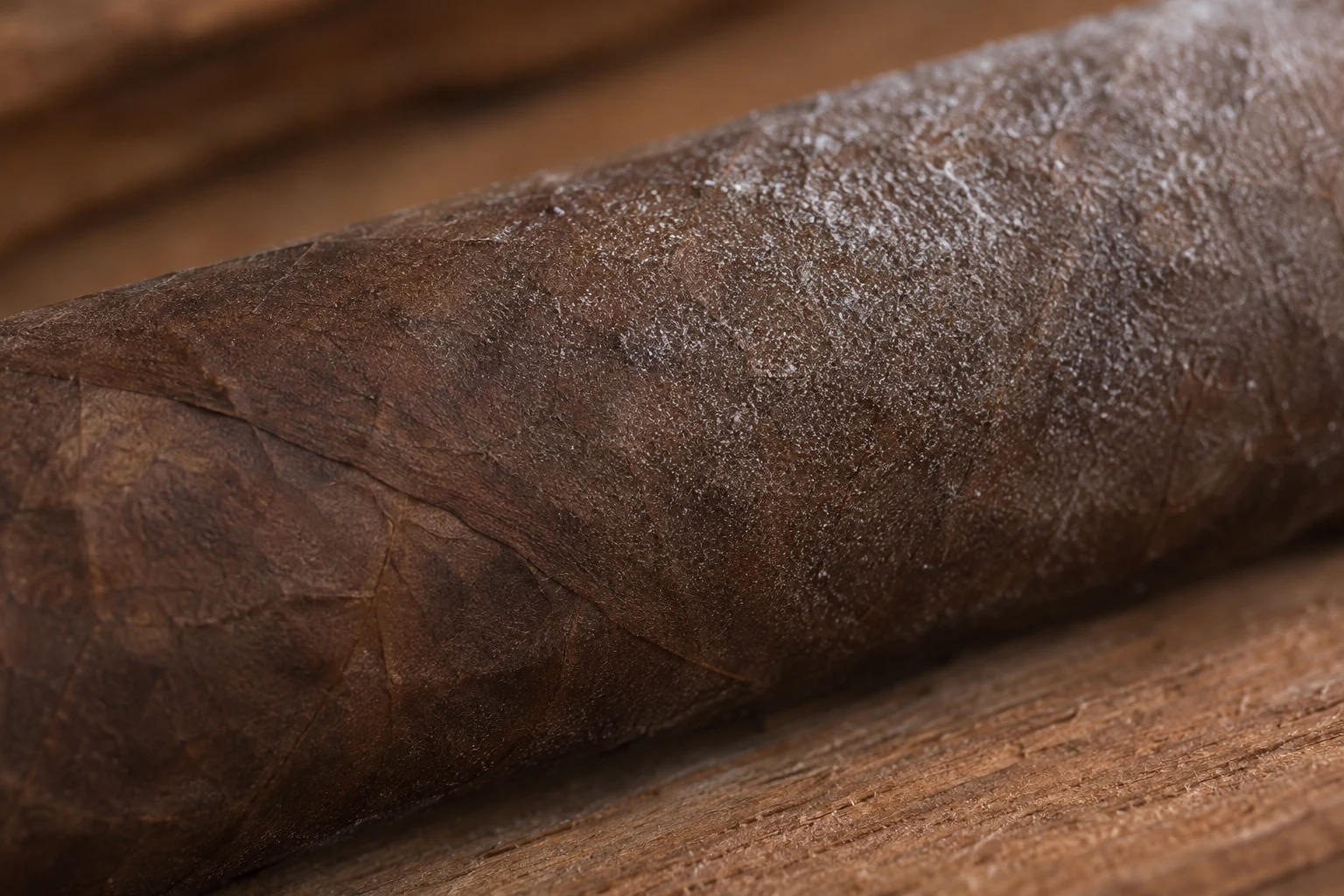
You cannot reliably establish that a deposit on a cigar is harmless “plume” from its colour or a photograph alone. Mould can be white, and some growth can be removed from a surface without eliminating contamination. If a deposit is unexplained, isolate the affected material and treat its identity as uncertain rather than assuming it is a normal sign of ageing.
What the terms describe
Mould is fungal growth. Under magnification, many moulds form networks of filaments called hyphae, and some structures produce spores. “Plume” or “bloom” is a term used in cigar discussions for an allegedly non-fungal surface deposit, often described as crystallised material. The name itself is not a laboratory identification or a finding that the object is safe.
This distinction matters when evaluating advice. Describing a deposit as powdery, pale or easy to brush away does not establish its chemical or biological composition. The available visual clues may justify concern, but they do not provide a dependable home test for separating every possible mineral, organic residue and fungal growth.
Why white does not mean harmless
The Canadian Conservation Institute explains that new mould growth is often white and that colour can change as reproductive structures develop. Its technical bulletin on mould and collections also describes how fungal filaments can penetrate porous materials. Both points undermine simple rules based only on surface colour.
Raised tufts, spreading patches or a filamentous appearance are reasons to suspect fungal growth. A flat-looking deposit is not automatically exempt. Lighting, camera processing and the scale of the image can hide texture. Even a sharp photograph cannot establish the absence of contamination below the visible surface or identify every organism present.
What an inspection can establish
An inspection can document where a deposit occurs, whether it affects neighbouring objects and whether it has changed since an earlier observation. Photographs taken under similar lighting are useful records. They are evidence of appearance and change, not a substitute for microscopic or other suitable examination when a definite identification is needed.
Avoid deliberately sniffing suspicious material or disturbing it to test whether the deposit comes off. Brushing can disperse particles, and easy removal does not establish that the original deposit was non-fungal. The useful initial question is whether isolation and further assessment are warranted, not whether a quick household trick can certify the material.
Responding to suspected mould
Separate affected material from unaffected contents while minimising handling and particle dispersal. Do not return it to shared storage merely because the visible deposit has been wiped away. Do not smoke a cigar with suspected mould. If disposal is appropriate, contain the material during handling rather than shaking debris into the surrounding space.
For an object retained for historical documentation, consult a conservator about assessment and handling. Preserving an artefact and making a material suitable for consumption are different objectives. A conservation treatment aimed at stabilising a collection object does not establish that it can be used safely as a tobacco product.
Investigate the environment as well
Examine the enclosure for condensation, leaking reservoirs, visibly damp areas and changes in temperature. Record the hygrometer reading and where the instrument was positioned. A normal-looking reading at one location does not rule out a wetter pocket elsewhere, a previous humidity excursion or an inaccurate sensor.
Mould depends on available moisture in the material, not only the number visible on the display. Time and local conditions also matter. The Canadian Conservation Institute's discussion of moisture and mould discusses the importance of local moisture conditions. A single universal RH threshold cannot certify an entire enclosure as mould-free.
Cleaning is not a safety certificate
An empty storage container may require cleaning or replacement of affected components, depending on its materials and the extent of contamination. Follow appropriate material-specific instructions. Porous wood and disposable humidifying media are not equivalent to a smooth nonporous surface, so a treatment suitable for one should not automatically be applied to another.
Do not apply household disinfectants, perfume, alcohol or other improvised treatments to tobacco in an attempt to make it usable. Removing a stain, stopping visible growth and removing all relevant contamination are different outcomes. The absence of a smell after treatment is not a reliable measure of any of them.
What to record before drawing a conclusion
A useful record includes the date, photographs, affected locations, recent refilling or wetting, temperature changes and the instrument's last reference check. If more than one object is affected, record the distribution. These observations can help explain an environmental problem even when the deposit itself remains unidentified.
Use wording that reflects the evidence: “unidentified white deposit” or “suspected mould” is more accurate than confidently calling an unexplained patch plume. This preserves the distinction between observation and interpretation. Uncertainty should remain visible until an appropriate examination resolves it; a familiar name does not provide that resolution.
Reader questions
Questions & answers
No questions yet. Ask the first one.